SDP explainer
/tools/sdp-explainer/Paste a WebRTC offer or answer and see every line: what it sets, which phase of the call reads it, and what breaks a rule, with the RFC for each.
Paste a WebRTC offer or answer and see every line: what it sets, which phase of the call reads it, and what breaks a rule, with the RFC for each.
The answer comes first, in the shape the input calls for. For one description, what it sets up, grouped as transport, security and media, with a first line saying whether these checks found anything; when they found something to fix, the problems lead, each located by its line. For a pair, whether the two settle a call. Then every line, and last, how it was read.
A WebRTC call starts with two blobs of text, an offer and an answer, written in SDP. Each line is read by a different part of the call, and the order they are written in (RFC 8866’s) is not the order the call uses them in. Paste one and the tool shows every line, what it sets in one sentence, and which phase reads it:
| Phase | Lines |
|---|---|
| Session | v=, o=, s=, t= |
| ICE (path) | c=, a=group, a=ice-options, a=ice-ufrag, a=ice-pwd, a=ice-lite, a=candidate, a=end-of-candidates |
| DTLS (keys) | a=fingerprint, a=setup, a=tls-id |
| RTP (streams) | m=, a=mid, a=msid, a=msid-semantic, a=ssrc, a=ssrc-group, a=extmap, a=extmap-allow-mixed, the direction attributes, simulcast’s a=rid and a=simulcast, a=bundle-only, and a data channel’s a=sctp-port and a=max-message-size |
| Codec | a=rtpmap, a=fmtp, a=ptime, a=maxptime |
| RTCP (feedback) | a=rtcp, a=rtcp-mux, a=rtcp-mux-only, a=rtcp-rsize, a=rtcp-fb |
A line the model does not know is Other, and the tool says so rather than guessing at it, as RFC 8866 tells a parser to ignore an attribute it does not understand.
SRTP has no line. Its keys come from DTLS, which runs on the media path after ICE has found it. The only trace of
it in the SDP is the profile name UDP/TLS/RTP/SAVPF and the fingerprint, which is a hash of a certificate and not a
key.
A candidate’s priority is decoded into its type preference, local preference and component, the way the ICE pair ranker decodes it.
Say you are adding simulcast to a video call: the browser should send three copies of the camera, small, medium and full size, so a server can forward each viewer the one that fits. You have the offer and want to know it says that.
1. Paste the offer. It’s the Simulcast + data channel sample. The lines that matter:
m=video 9 UDP/TLS/RTP/SAVPF 96 97a=rid:q senda=rid:h senda=rid:f senda=simulcast:send q;h;fm=application 9 UDP/DTLS/SCTP webrtc-datachannel2. Press Run, and read the summary.
This SDP Offer (a=setup:actpass), 2 media sections No problems found by these checks, and 1 note.Transport ICE full, ufrag Ab3d Candidates none yet BUNDLE mid 0 1Security DTLS role either; the answerer chooses Fingerprints sha-256 2 fingerprintsMedia Sections video mid 0; application mid 1 Codecs VP8/90000 pt 96, rtx/90000 pt 97 rtcp-mux yes3. Read the note under it. One row, worth knowing and nothing to fix:
Worth knowing, nothing to fixnote line 8 no a=tls-id: RFC 8842 asks for one, but Chrome, Firefox and aiortc never send it, and all of them accept a description without it4. Read the lines. a=simulcast:send q;h;f reads “Simulcast: this side will send 3 encodings, q, h, f, each one a
separate copy of the same source at its own resolution or bitrate”, and each a=rid line is one of those encodings.
The data channel section is read as SCTP inside the DTLS connection, so it isn’t held to the audio rules.
5. Break it on purpose. Delete a=rid:f send and Run again. Now the problems lead, and the error is first:
What to fix, worst firsterror line 32 m= section 1: a=simulcast names rid f, which no a=rid line in this section declares (RFC 8853 section 5.1)note line 8 no a=tls-id: ...The summary under it says “1 error found by these checks: a WebRTC stack may refuse it.” A receiver must not use that encoding, so the server would only ever see two copies.
Paste the answer into the second box, and the result leads with what the two settle: who controls ICE, who sends the DTLS ClientHello, and which codec both list.
| Severity | Check | Source |
|---|---|---|
| error | the first line is not v=0 (the whole input is refused) | RFC 8866 section 5.1 |
| error | the profile is not UDP/TLS/RTP/SAVPF, or UDP/DTLS/SCTP for a data channel | RFC 9429 section 5.1.2; RFC 8841 section 4.2 |
| error | no c= line in the section or the session | RFC 8866 section 5.7 |
| error | no a=mid | RFC 9429 section 5.2.1 |
| error | a ufrag under 4 or a password under 22 characters | RFC 8839 section 5.4 |
| warning | a ufrag or password with a character outside letters, digits, + and / | RFC 8839 section 5.1 |
| error | no a=fingerprint | RFC 9429 section 5.1.2 |
| note | no a=tls-id anywhere in the description, said once | RFC 8842 sections 5.2 and 5.3 |
| error | no a=rtcp-mux, except in a data channel section, which has no RTCP | RFC 5761; RFC 8834 section 4.5 |
| error | Opus not written opus/48000/2 | RFC 7587 section 7 |
| error | a server-reflexive, peer-reflexive or relayed candidate without raddr and rport | RFC 8839 section 5.1 |
| note | a priority that does not decode to RFC 8445’s recommended type preference, or to its own component | RFC 8445 section 5.1.2 |
| warning | candidates, but none at the m= port and c= address | RFC 8839 section 4.2.1.2 |
| warning | no candidates, and not port 9 with IN IP4 0.0.0.0, unless the section is bundle-only with port 0 | RFC 9429 section 5.2.1; RFC 9143 section 6 |
| error | a=simulcast names a rid no a=rid line declares, or in the other direction | RFC 8853 section 5.1 |
| error | a=ice-lite inside a media section | RFC 8839 section 5.3 |
| error | ICE-lite with a candidate that is not a host | RFC 8445 section 2.5 |
| error | BUNDLE names a mid no section has | RFC 9143 |
| note | a=ice-lite in an offer, which a JSEP endpoint never sends | RFC 9429 section 5.2.1 |
An error is a MUST broken. A warning is a SHOULD, or a value real stacks accept anyway. A note is a decoded oddity.
A missing line is reported on its section’s m= line, since it has no line of its own.
Why a=tls-id is only a note. RFC 8842 does ask every offer and answer for one. But the stacks that make the calls
don’t write it: libwebrtc, which Chrome and Safari use, has no tls-id in its SDP code
(webrtc_sdp.cc,
a mirror of the m125 release), nor does Firefox’s
(SdpAttribute.h),
and the aiortc answer among the samples, a real capture, has none. Version 1 warned on every section of every such
description, which buried the problems that do stop a call.
Paste the other side’s description too and the tool reads what the two settle between them:
| Field | Rule |
|---|---|
| ICE roles | One side lite: the full agent controls. Both full, or both lite: the offerer controls (RFC 8445 section 6.1.1) |
| ClientHello sent by | The side whose a=setup resolves to active (RFC 5763 section 5). Two actpass are two offers, and settle nothing |
| Codec agreed | Payload types both list with the same encoding |
| BUNDLE | The same mids grouped on both sides |
| rtcp-mux | On both |
| Fingerprints | Present on both, and different |
Only one of them is a capture, and it is not a browser’s:
| Sample | Made how |
|---|---|
| Alice’s offer | Constructed: the series’ running example, a full agent with three candidates |
| Alice, before gathering | Constructed: trickle ICE, port 9 and 0.0.0.0, no candidates yet |
| The assistant’s answer | Constructed: ICE-lite, one host candidate, a=setup:active |
| aiortc’s answer | Captured from aiortc answering Alice’s offer: three fingerprints, recvonly, no a=tls-id |
| RFC 9429’s example offer | RFC 9429 section 7.1’s offer, with its layout undone: blank lines removed and the wrapped fingerprint joined into one line |
| Simulcast + data channel | Constructed: one VP8 source sent as three rids, q, h and f, and an SCTP data channel, both bundled |
| A broken offer | Constructed: Alice’s offer with five mistakes, which the checks report as six errors |
All the addresses are from the documentation ranges, and the credentials are made up.
Lines are trimmed and blank ones dropped, so CRLF, LF and a description copied with an RFC’s indentation all read the same.
a=tls-ida=setupa=ridindex.ts/** * An SDP explainer: paste an offer or an answer and see every line, what it sets, and which phase of the call reads * it: ICE finding the path, DTLS making the keys, RTP and its codec carrying the sound, RTCP reporting on it. * * Three things a reader cannot easily do by eye, each a place a hand-written description goes wrong: * * 1. **Group the lines by the phase that reads them.** An SDP is written in RFC 8866's fixed order, which is the * order a parser wants and not the order a call uses it in. The phase table is the model's, and a line it does * not know is "Other": the tool says so rather than guessing, as RFC 8866 tells a parser to ignore what it does * not understand. * 2. **Check it against the rules a WebRTC stack applies**, each with the RFC sentence behind it: an error for a * MUST broken, a warning for a SHOULD or a value real stacks accept anyway, a note for a decoded oddity. * 3. **Read two descriptions as a pair**: who controls ICE, who sends the DTLS ClientHello, which codec both list. * * The fixtures were first the output of a reference model written beside the post; the rules have moved on since * (simulcast, data channels, bundle-only sections, and the tls-id rule real stacks ignore), each with its own * fixture and test. Candidate priorities are decoded the way the ICE pair ranker decodes them, and never recomputed: they are what * the agent sent. * * What it deliberately cannot do: check a fingerprint against a certificate. It has no certificate, so it can only * say one is present and whether the two sides' differ. The DTLS handshake does the real check. */import type { Cell, Field, Output, TextTone, Tool } from "@toolbench/sdk";
type Input = { sdp: string; other: string; show: string };
class InputError extends Error { readonly input: string; constructor(message: string, input: string) { super(message); this.input = input; }}
export const PHASES = ["Session", "ICE (path)", "DTLS (keys)", "RTP (streams)", "Codec", "RTCP (feedback)"] as const;export type Phase = (typeof PHASES)[number] | "Other";const SHORT: Record<Phase, string> = { Session: "Session", "ICE (path)": "ICE", "DTLS (keys)": "DTLS", "RTP (streams)": "RTP", Codec: "Codec", "RTCP (feedback)": "RTCP", Other: "Other",};
/* * Which phase reads each attribute. `c=` is ICE's because it is the default candidate's address, which an ICE agent * replaces with the candidates; `a=group` is ICE's because BUNDLE is what lets one path carry every section. */const ATTR_PHASE: Record<string, Phase> = { group: "ICE (path)", "ice-options": "ICE (path)", "ice-ufrag": "ICE (path)", "ice-pwd": "ICE (path)", "ice-lite": "ICE (path)", candidate: "ICE (path)", "end-of-candidates": "ICE (path)", fingerprint: "DTLS (keys)", setup: "DTLS (keys)", "tls-id": "DTLS (keys)", mid: "RTP (streams)", msid: "RTP (streams)", "msid-semantic": "RTP (streams)", ssrc: "RTP (streams)", "ssrc-group": "RTP (streams)", rid: "RTP (streams)", simulcast: "RTP (streams)", "bundle-only": "RTP (streams)", "sctp-port": "RTP (streams)", "max-message-size": "RTP (streams)", extmap: "RTP (streams)", "extmap-allow-mixed": "RTP (streams)", sendrecv: "RTP (streams)", sendonly: "RTP (streams)", recvonly: "RTP (streams)", inactive: "RTP (streams)", rtpmap: "Codec", fmtp: "Codec", ptime: "Codec", maxptime: "Codec", rtcp: "RTCP (feedback)", "rtcp-mux": "RTCP (feedback)", "rtcp-mux-only": "RTCP (feedback)", "rtcp-rsize": "RTCP (feedback)", "rtcp-fb": "RTCP (feedback)",};
export function phaseOf(line: string): Phase { const head = line.slice(0, 2); if (head === "v=" || head === "o=" || head === "s=" || head === "t=") return "Session"; if (head === "c=") return "ICE (path)"; if (head === "m=") return "RTP (streams)"; if (head === "a=") return ATTR_PHASE[line.slice(2).split(":", 1)[0]!] ?? "Other"; return "Other";}
const TYPE_PREF: Record<number, string> = { 126: "host", 110: "prflx", 100: "srflx", 0: "relay" };
/** RFC 8445 section 5.1.2.1: priority = 2^24 x type preference + 2^8 x local preference + (256 - component). */export function decodePriority(p: number) { return { type: Math.floor(p / 2 ** 24), local: Math.floor(p / 2 ** 8) % 2 ** 16, component: 256 - (p % 256) };}
export type Severity = "error" | "warning" | "note";export interface Problem { severity: Severity; message: string; /** Index into `Model.lines`: the line the problem is about, or the m= line of the section that lacks something. */ at: number;}
interface Line { /** Its line number in the pasted text, blank lines included, so a reader can find it. */ n: number; text: string; phase: Phase; what: string;}
interface Candidate { at: number; foundation: string; component: number; transport: string; priority: number; address: string; port: number; type: string; raddr?: string; rport?: string;}
export interface Model { lines: Line[]; problems: Problem[]; kind: "offer" | "answer" | "unknown"; setup: string; lite: boolean; ufrag: string; candidates: Candidate[]; trickle: string; fingerprints: string[]; media: string[]; codecs: string[]; bundle: string[] | null; rtcpMux: boolean; counts: Record<Phase, number>;}
const ICE_CHAR = /^[A-Za-z0-9+/]+$/;const KIND_OF_SETUP: Record<string, Model["kind"]> = { actpass: "offer", active: "answer", passive: "answer" };const ROLE: Record<string, string> = { actpass: "either; the answerer chooses", active: "DTLS client: sends the ClientHello", passive: "DTLS server: waits for the ClientHello",};
/** Every `a=<name>` or `a=<name>:<value>` in a block of line indices, with where it is. */function attrs(lines: string[], block: number[], name: string): { value: string; at: number }[] { const out: { value: string; at: number }[] = []; for (const i of block) { const x = lines[i]!; if (x === `a=${name}`) out.push({ value: "", at: i }); else if (x.startsWith(`a=${name}:`)) out.push({ value: x.slice(name.length + 3), at: i }); } return out;}
function parseCandidate(value: string, at: number): Candidate | null { const f = value.split(/\s+/); if (f.length < 8 || f[6] !== "typ" || !/^\d+$/.test(f[1]!) || !/^\d+$/.test(f[3]!) || !/^\d+$/.test(f[5]!)) return null; const raddr = f.indexOf("raddr"); const rport = f.indexOf("rport"); return { at, foundation: f[0]!, component: Number(f[1]), transport: f[2]!, priority: Number(f[3]), address: f[4]!, port: Number(f[5]), type: f[7]!, ...(raddr > 7 && f[raddr + 1] ? { raddr: f[raddr + 1] } : {}), ...(rport > 7 && f[rport + 1] ? { rport: f[rport + 1] } : {}), };}
/** * RFC 8853's simulcast: `a=simulcast:send h;m;l` names the encodings a sender offers, and each name must be declared by * an `a=rid:<name> send` line in the same section (RFC 8853 section 5.1; RFC 8851 section 4). A `~` before a name pauses * that encoding, and `,` separates alternatives for one encoding. */function checkSimulcast(lines: string[], m: number[], i: number, add: (s: Severity, message: string, at: number) => void): void { const rids = new Map(attrs(lines, m, "rid").map((r) => { const [id, dir] = r.value.split(/\s+/); return [id ?? "", dir ?? ""] as const; })); for (const sim of attrs(lines, m, "simulcast")) { const f = sim.value.trim().split(/\s+/); for (let k = 0; k + 1 < f.length; k += 2) { const dir = f[k]!; if (dir !== "send" && dir !== "recv") { add("error", `m= section ${i}: a=simulcast direction "${dir}" is not send or recv (RFC 8853 section 5.1)`, sim.at); continue; } for (const name of f[k + 1]!.split(/[;,]/).map((x) => x.replace(/^~/, ""))) { const declared = rids.get(name); if (declared === undefined) add("error", `m= section ${i}: a=simulcast names rid ${name}, which no a=rid line in this section declares (RFC 8853 section 5.1)`, sim.at); else if (declared !== dir) add("error", `m= section ${i}: rid ${name} is declared ${declared} but a=simulcast lists it to ${dir} (RFC 8853 section 5.1)`, sim.at); } } }}
/** * Reads one description. Exported for the tests, which check its properties over every sample. * * Lines are trimmed and blank ones dropped, so CRLF, LF and a description copied with an RFC's indentation all * read the same. */export function explain(text: string, input = "sdp"): Model { const numbered: { n: number; text: string }[] = []; text.split(/\r?\n/).forEach((raw, i) => { const t = raw.trim(); if (t) numbered.push({ n: i + 1, text: t }); }); const lines = numbered.map((l) => l.text); if (lines[0] !== "v=0") throw new InputError("Not SDP: the first line must be v=0 (RFC 8866 section 5.1)", input);
const sessionBlock: number[] = []; const mediaBlocks: number[][] = []; lines.forEach((x, i) => { if (x.startsWith("m=")) mediaBlocks.push([]); (mediaBlocks.at(-1) ?? sessionBlock).push(i); }); const problems: Problem[] = []; const add = (severity: Severity, message: string, at: number) => problems.push({ severity, message, at }); const anyAttr = (block: number[], name: string) => { const own = attrs(lines, block, name); return own.length ? own : attrs(lines, sessionBlock, name); };
const liteAt = attrs(lines, sessionBlock, "ice-lite"); const lite = liteAt.length > 0; for (const m of mediaBlocks) for (const a of attrs(lines, m, "ice-lite")) add("error", "a=ice-lite is session-level only (RFC 8839 section 5.3)", a.at); const setups = mediaBlocks.flatMap((m) => anyAttr(m, "setup")); const setup = setups[0]?.value ?? ""; const kind = KIND_OF_SETUP[setup] ?? "unknown";
const candidates: Candidate[] = []; const mids: string[] = []; const media: string[] = []; const codecs: string[] = []; const fingerprints: string[] = []; let rtcpMux = mediaBlocks.length > 0; let hasTlsId = false; mediaBlocks.forEach((m, k) => { const i = k + 1; const mAt = m[0]!; const mline = lines[mAt]!.slice(2).split(/\s+/); const port = Number(mline[1]); const proto = mline[2] ?? ""; if (mline.length < 4 || !/^\d+$/.test(mline[1] ?? "")) { add("error", `m= section ${i}: the m= line is not <media> <port> <proto> <fmt> (RFC 8866 section 5.14)`, mAt); } /* * A data channel is an m=application section of SCTP over DTLS, RFC 8841, and has no RTP: no RTP profile, no * rtcp-mux, no codecs. Holding it to the audio rules flagged every offer with a data channel as broken. */ const data = mline[0] === "application"; if (data ? !/^(UDP|TCP)\/DTLS\/SCTP$/.test(proto) : proto !== "UDP/TLS/RTP/SAVPF") { add("error", `m= section ${i}: proto ${proto}, not ${data ? "UDP/DTLS/SCTP (RFC 8841 section 4.2)" : "UDP/TLS/RTP/SAVPF (RFC 9429 section 5.1.2)"}`, mAt); } const bundleOnly = port === 0 && attrs(lines, m, "bundle-only").length > 0; const cLines = m.filter((j) => lines[j]!.startsWith("c=")); const c = cLines.length ? cLines : sessionBlock.filter((j) => lines[j]!.startsWith("c=")); const cAddr = c.length ? (lines[c[0]!]!.split(/\s+/)[2] ?? "") : ""; if (!c.length) add("error", `m= section ${i}: no c= line (RFC 8866 section 5.7)`, mAt); const mid = attrs(lines, m, "mid"); mids.push(...mid.map((x) => x.value)); media.push(mid[0]?.value === undefined ? `${mline[0]}, no mid` : `${mline[0]} mid ${mid[0].value}`); if (!mid.length) add("error", `m= section ${i}: no a=mid (RFC 9429 section 5.2.1)`, mAt);
const ufrag = anyAttr(m, "ice-ufrag")[0]; const pwd = anyAttr(m, "ice-pwd")[0]; for (const [name, a, min] of [["ice-ufrag", ufrag, 4], ["ice-pwd", pwd, 22]] as const) { const len = a?.value.length ?? 0; if (len < min) add("error", `m= section ${i}: ${name} is ${len} characters, at least ${min} (RFC 8839 section 5.4)`, a?.at ?? mAt); else if (len > 256) add("error", `m= section ${i}: ${name} is ${len} characters, at most 256 (RFC 8839 section 5.4)`, a?.at ?? mAt); } for (const [name, a] of [["ice-ufrag", ufrag], ["ice-pwd", pwd]] as const) { if (a?.value && !ICE_CHAR.test(a.value)) { const bad = [...new Set(a.value.replace(/[A-Za-z0-9+/]/g, ""))].sort(); add("warning", `m= section ${i}: ${name} has ${bad.map((b) => `'${b}'`).join(" ")}, not an ice-char (RFC 8839 section 5.1)`, a.at); } } const fp = anyAttr(m, "fingerprint"); fingerprints.push(...fp.map((x) => x.value)); if (!fp.length) add("error", `m= section ${i}: no a=fingerprint, so negotiation fails (RFC 9429 section 5.1.2)`, mAt); if (anyAttr(m, "tls-id").length) hasTlsId = true; if (!data && !attrs(lines, m, "rtcp-mux").length) { rtcpMux = false; add("error", `m= section ${i}: no a=rtcp-mux (RFC 5761; RFC 8834 section 4.5)`, mAt); } for (const r of attrs(lines, m, "rtpmap")) { const [pt, enc] = r.value.split(/\s+/, 2); if (!pt || !enc) { add("error", `a=rtpmap is not <payload type> <encoding>/<clock rate> (RFC 8866 section 6.6)`, r.at); continue; } codecs.push(`${enc} pt ${pt}`); if (enc.toLowerCase().startsWith("opus/") && enc.toLowerCase() !== "opus/48000/2") { add("error", `opus must be opus/48000/2 (RFC 7587 section 7), not ${enc}`, r.at); } } const cands: Candidate[] = []; for (const a of attrs(lines, m, "candidate")) { const cand = parseCandidate(a.value, a.at); if (!cand) { add("error", "a=candidate is not <foundation> <component> <transport> <priority> <address> <port> typ <type> (RFC 8839 section 5.1)", a.at); continue; } cands.push(cand); const d = decodePriority(cand.priority); if (TYPE_PREF[d.type] !== cand.type || d.component !== cand.component) { add( "note", `candidate ${cand.foundation} (${cand.type}): priority ${cand.priority} decodes to type preference ${d.type}, local preference ${d.local}, component ${d.component}; not RFC 8445's recommended values for ${cand.type}`, a.at, ); } if (cand.type !== "host" && !(cand.raddr && cand.rport)) add("error", `candidate ${cand.foundation} (${cand.type}) has no raddr/rport (RFC 8839 section 5.1)`, a.at); } candidates.push(...cands); if (cands.length && c.length && !cands.some((x) => x.address === cAddr && x.port === port)) { add("warning", `m= section ${i}: m= port and c= address match no candidate (RFC 8839 section 4.2.1.2)`, mAt); } // A bundle-only section has port 0 on purpose: it is carried on the bundle's transport (RFC 9143 section 6). if (!cands.length && c.length && !bundleOnly && !(port === 9 && cAddr === "0.0.0.0")) { add("warning", `m= section ${i}: no candidates, so port 9 and IN IP4 0.0.0.0 expected (RFC 9429 section 5.2.1)`, mAt); } checkSimulcast(lines, m, i, add); const notHost = cands.find((x) => x.type !== "host"); if (lite && notHost) add("error", "ICE-lite agents only use host candidates (RFC 8445 section 2.5)", notHost.at); }); /* * ⚠️ Once per description, and a note, not a warning on every section. RFC 8842 sections 5.2 and 5.3 do ask for * a=tls-id, but libwebrtc (Chrome, Safari), Firefox and aiortc never write one, and every one of them accepts a * description without it. A warning on every section of every browser's offer is noise that hides real problems. */ if (mediaBlocks.length && !hasTlsId) { add("note", "no a=tls-id: RFC 8842 asks for one, but Chrome, Firefox and aiortc never send it, and all of them accept a description without it", mediaBlocks[0]![0]!); } const groups = sessionBlock.filter((j) => lines[j]!.startsWith("a=group:BUNDLE")); for (const g of groups) { for (const mid of lines[g]!.split(/\s+/).slice(1)) { if (!mids.includes(mid)) add("error", `BUNDLE names mid ${mid}, which no m= section has (RFC 9143)`, g); } } if (kind === "offer" && lite) add("note", "a=ice-lite in an offer: a JSEP endpoint never sends this (RFC 9429 section 5.2.1)", liteAt[0]!.at);
const ctx = { kind, setup, lite }; const described = numbered.map((l) => ({ ...l, phase: phaseOf(l.text), what: describe(l.text, ctx) })); const counts = Object.fromEntries([...PHASES, "Other"].map((p) => [p, 0])) as Record<Phase, number>; for (const l of described) counts[l.phase]++; const hasEnd = mediaBlocks.some((m) => attrs(lines, m, "end-of-candidates").length > 0); const firstUfrag = mediaBlocks[0] ? anyAttr(mediaBlocks[0], "ice-ufrag")[0] : attrs(lines, sessionBlock, "ice-ufrag")[0]; const bundle = groups.length ? lines[groups[0]!]!.split(/\s+/).slice(1) : null; return { lines: described, problems, kind, setup, lite, ufrag: firstUfrag?.value ?? "", candidates, trickle: hasEnd ? "complete (a=end-of-candidates)" : candidates.length ? "more may trickle" : "none yet", fingerprints, media, codecs, bundle, rtcpMux, counts, };}
// ---------------------------------------------------------------------------------------------------------------// What each line sets. One plain sentence each, and only for what the model knows: an attribute it does not know is// said to be unknown rather than given a plausible meaning.// ---------------------------------------------------------------------------------------------------------------
const UNKNOWN = "Not a line this explainer knows, so it does not guess; an SDP parser ignores attributes it does not understand (RFC 8866 section 5).";
const EXTENSIONS: Record<string, string> = { "urn:ietf:params:rtp-hdrext:ssrc-audio-level": "the sender's audio level (RFC 6464), which SRTP authenticates but does not encrypt, so it is readable on the path", "urn:ietf:params:rtp-hdrext:csrc-audio-level": "the level of each voice a mixer mixed (RFC 6465), authenticated by SRTP but not encrypted", "urn:ietf:params:rtp-hdrext:sdes:mid": "the section's mid, so a receiver can tell which m= section a packet belongs to on a bundled port (RFC 9143)", "urn:ietf:params:rtp-hdrext:sdes:rtp-stream-id": "the RtpStreamId, which names one encoding of a simulcast source (RFC 8852)", "urn:ietf:params:rtp-hdrext:sdes:repaired-rtp-stream-id": "the RtpStreamId of the stream a repair stream repairs (RFC 8852)", "urn:ietf:params:rtp-hdrext:toffset": "the transmission time offset, how late a packet left after its timestamp (RFC 5450)",};
const CODECS: Record<string, string> = { pcmu: "G.711 mu-law", pcma: "G.711 A-law", g722: "G.722", "telephone-event": "DTMF digits and other telephony events, sent as events rather than sound (RFC 4733)", cn: "comfort noise (RFC 3389)", red: "redundant audio (RFC 2198)", rtx: "retransmission of lost packets (RFC 4588)", ulpfec: "forward error correction (RFC 5109)", vp8: "VP8 video (RFC 7741)", vp9: "VP9 video", h264: "H.264 video (RFC 6184)", h265: "H.265 video (RFC 7798)", av1: "AV1 video",};
const FMTP: Record<string, (v: string) => string> = { minptime: (v) => `minptime=${v}, at least ${v} ms of audio a packet, a parameter RFC 7587 does not define`, useinbandfec: (v) => (v === "1" ? "useinbandfec=1, the decoder can use Opus's in-band FEC (RFC 7587)" : `useinbandfec=${v} (RFC 7587)`), usedtx: (v) => `usedtx=${v}, whether the decoder prefers silence to be sent as DTX (RFC 7587)`, stereo: (v) => `stereo=${v}, ${v === "1" ? "the decoder prefers stereo" : "the decoder prefers mono"} (RFC 7587)`, "sprop-stereo": (v) => `sprop-stereo=${v}, whether the sender is likely to send stereo (RFC 7587)`, cbr: (v) => `cbr=${v}, whether the decoder prefers a constant bitrate (RFC 7587)`, maxaveragebitrate: (v) => `maxaveragebitrate=${v}, the most the receiver wants on average, in b/s (RFC 7587)`, maxplaybackrate: (v) => `maxplaybackrate=${v}, a hint at the receiver's highest output sample rate (RFC 7587)`, apt: (v) => `apt=${v}, it retransmits payload type ${v} (RFC 4588)`, "packetization-mode": (v) => `packetization-mode=${v} (RFC 6184)`, "profile-level-id": (v) => `profile-level-id=${v} (RFC 6184)`, "level-asymmetry-allowed": (v) => `level-asymmetry-allowed=${v} (RFC 6184)`,};
const FEEDBACK: Record<string, string> = { nack: "generic NACK, asking for lost packets again (RFC 4585)", "nack pli": "picture loss indication, asking for a new picture (RFC 4585)", "nack sli": "slice loss indication (RFC 4585)", "nack rpsi": "reference picture selection indication (RFC 4585)", "ccm fir": "full intra request, asking for a key frame (RFC 5104)", "ccm tmmbr": "a temporary maximum bitrate request (RFC 5104)", "transport-cc": "transport-wide congestion control feedback, from an IETF draft rather than an RFC", "goog-remb": "Google's REMB bandwidth estimate, from an IETF draft rather than an RFC",};
const DIRECTION: Record<string, string> = { sendrecv: "This side sends and receives media in this section (RFC 8866 section 6.7).", sendonly: "This side only sends media in this section (RFC 8866 section 6.7).", recvonly: "This side only receives media in this section (RFC 8866 section 6.7).", inactive: "This side neither sends nor receives media in this section (RFC 8866 section 6.7).",};
const CAND_NAME: Record<string, string> = { host: "Host", srflx: "Server-reflexive", prflx: "Peer-reflexive", relay: "Relayed" };
function describeCandidate(value: string): string { const c = parseCandidate(value, 0); if (!c) return "A candidate line that does not parse, so its address cannot be read (RFC 8839 section 5.1)."; const d = decodePriority(c.priority); const comp = c.component === 1 ? "for RTP" : c.component === 2 ? "for RTCP" : `for component ${c.component}`; const related = c.raddr && c.rport ? `${c.raddr}:${c.rport}` : ""; const how = c.type === "srflx" && related ? `, the NAT's mapping of ${related}` : c.type === "relay" ? `, an address on a TURN server${related ? ` that saw this side as ${related}` : ""}` : c.type === "prflx" ? ", learned from a connectivity check" : ""; return `${CAND_NAME[c.type] ?? `A "${c.type}"`} candidate ${c.address}:${c.port} over ${c.transport.toUpperCase()} ${comp}${how}; priority ${c.priority} is type preference ${d.type}, local preference ${d.local}, component ${d.component} (RFC 8445 section 5.1.2).`;}
function describe(line: string, ctx: { kind: Model["kind"]; setup: string; lite: boolean }): string { const type = line.slice(0, 2); const value = line.slice(2); const f = value.split(/\s+/); switch (type) { case "v=": return "The SDP version; 0 is the only one there is (RFC 8866 section 5.1)."; case "o=": { const addr = f[5] === "0.0.0.0" ? "; its address, 0.0.0.0, is a placeholder so no local IP leaks (RFC 9429 section 5.2.1)" : `, from ${f[5]}`; return `The origin: session id ${f[1]} and version ${f[2]}, which goes up whenever the description changes (RFC 8866 section 5.2)${addr}.`; } case "s=": return value === "-" || value === "" ? "The session name; a dash means it has none (RFC 8866 section 5.3)." : `The session name, "${value}" (RFC 8866 section 5.3).`; case "t=": return value === "0 0" ? "When the session is active; 0 0 means it is unbounded and permanent (RFC 8866 section 5.9)." : `When the session is active: ${value}, as NTP seconds (RFC 8866 section 5.9).`; case "c=": return f[2] === "0.0.0.0" ? "The connection address, 0.0.0.0: a placeholder, since no candidate is known yet (RFC 9429 section 5.2.1)." : `The connection address, ${f[2]}, the default candidate's; an ICE agent uses the candidates instead (RFC 8839 section 4.2.1.2).`; case "m=": { const port = f[1] === "9" ? "port 9, the placeholder before any candidate is known" : f[1] === "0" ? "port 0, so it is rejected, or bundle-only and carried on another section's port" : `port ${f[1]}`; const proto = f[2] === "UDP/TLS/RTP/SAVPF" ? "UDP/TLS/RTP/SAVPF, which is RTP with feedback, protected by SRTP whose keys come from DTLS, over UDP" : f[2] === "UDP/DTLS/SCTP" ? "UDP/DTLS/SCTP, a data channel: SCTP messages inside the DTLS connection, over UDP" : `profile ${f[2]}`; if (f[3] === "webrtc-datachannel") return `Starts a data channel section on ${port}: SCTP messages inside the DTLS connection, over ${f[2]?.startsWith("TCP") ? "TCP" : "UDP"} (RFC 8841 section 4.2).`; const fmts = f.slice(3); return `Starts ${/^[aeiou]/.test(f[0] ?? "") ? "an" : "a"} ${f[0]} section on ${port}, ${proto}, offering payload type${fmts.length === 1 ? "" : "s"} ${fmts.join(", ")} (RFC 8866 section 5.14).`; } case "b=": return `A bandwidth limit, ${value}; none of the six phases owns it (RFC 8866 section 5.8).`; case "i=": return "A free-text title (RFC 8866 section 5.4); nothing in the call reads it."; } if (type !== "a=") return UNKNOWN; const colon = value.indexOf(":"); const name = colon < 0 ? value : value.slice(0, colon); const v = colon < 0 ? "" : value.slice(colon + 1); const vf = v.split(/\s+/); switch (name) { case "group": if (vf[0] === "BUNDLE") return `Bundles the sections with mid ${vf.slice(1).join(", ")} onto one transport, so one ICE path and one DTLS handshake serve them all (RFC 9143).`; if (vf[0] === "LS") return `Lip sync: the sections with mid ${vf.slice(1).join(", ")} are played in sync (RFC 5888).`; return `Groups the sections with mid ${vf.slice(1).join(", ")} under the semantics "${vf[0]}" (RFC 5888).`; case "ice-options": { const known: Record<string, string> = { trickle: "trickle, so candidates may follow the description (RFC 8840)", ice2: "ice2, the ICE of RFC 8445 rather than the older RFC 5245 (RFC 8445 section 10)", }; return `ICE options: ${vf.map((o) => known[o] ?? `${o}, which this explainer does not know`).join("; ")}.`; } case "ice-ufrag": return `The ICE username fragment, ${v}; checks sent to this side carry it first in their STUN USERNAME (RFC 8445 section 7.2.2).`; case "ice-pwd": return `The ICE password, ${v.length} characters; checks sent to this side are signed with it, in MESSAGE-INTEGRITY (RFC 8445 section 7.2.2).`; case "ice-lite": return "This side is ICE-lite: it has only host candidates and answers checks without sending any, so a full agent on the other side controls (RFC 8445 sections 2.5 and 6.1.1)."; case "candidate": return describeCandidate(v); case "end-of-candidates": return "No more candidates will trickle for this section (RFC 8840 section 8)."; case "fingerprint": return `The ${vf[0]} hash of the certificate this side will present in the DTLS handshake, which the other side must match or end the call; a hash, not a key (RFC 5763 section 5).`; case "setup": if (v === "actpass") return "DTLS role: either; the answerer picks, and SHOULD pick active, so the offerer usually waits for a ClientHello (RFC 9429 section 5.3.1)."; if (v === "active") return "DTLS role: client, so this side sends the ClientHello (RFC 5763 section 5)."; if (v === "passive") return "DTLS role: server, so this side waits for the other side's ClientHello (RFC 5763 section 5)."; return `DTLS role "${v}", which is not one of actpass, active and passive (RFC 5763 section 5).`; case "tls-id": return "This side's half of the name of the DTLS association; the two sides' tls-id values together identify it, and a new value means a new handshake (RFC 8842 section 4)."; case "mid": return `Names this section "${v}"; BUNDLE lists it, and the mid header extension stamps it on packets so a receiver can tell sections apart on one port (RFC 9143).`; case "msid": return vf[1] ? `Ties this section to media stream ${vf[0]}, track ${vf[1]}, the ids the other side's WebRTC API sees (RFC 8830).` : `Ties this section to media stream ${vf[0]}, the id the other side's WebRTC API sees (RFC 8830).`; case "msid-semantic": return "Announces WebRTC media stream ids; it comes from early drafts of msid, and RFC 8830 removed that mechanism, so nothing needs it."; case "ssrc": { const [ssrc, ...rest] = vf; const attr = rest.join(" "); const ai = attr.indexOf(":"); const aname = ai < 0 ? attr : attr.slice(0, ai); const aval = ai < 0 ? "" : attr.slice(ai + 1); return aname === "cname" ? `SSRC ${ssrc}, the id in every RTP packet of this stream, with canonical name ${aval} (RFC 5576).` : `SSRC ${ssrc}'s "${aname}"${aval ? ` is ${aval}` : ""} (RFC 5576).`; } case "rid": { const [id, dir, ...rest] = vf; const limits = rest.join(" "); return `Declares rid ${id}, one encoding this side will ${dir === "recv" ? "receive" : "send"}${limits ? `, limited to ${limits}` : ""}; a=simulcast lists these, and each packet names its encoding in the rtp-stream-id header extension (RFC 8851).`; } case "simulcast": { const pieces: string[] = []; for (let k = 0; k + 1 < vf.length; k += 2) { const names = vf[k + 1]!.split(";"); const paused = names.filter((x) => x.startsWith("~")).map((x) => x.slice(1)); pieces.push(`${vf[k] === "recv" ? "receive" : "send"} ${names.length} encoding${names.length === 1 ? "" : "s"}, ${names.map((x) => x.replace(/^~/, "")).join(", ")}${paused.length ? `, with ${paused.join(", ")} paused for now` : ""}`); } return `Simulcast: this side will ${pieces.join(", and ")}, each one a separate copy of the same source at its own resolution or bitrate, so a server can forward each viewer the one that fits (RFC 8853).`; } case "bundle-only": return "This section has no transport of its own: it only works if the other side bundles it, which is why its port is 0 (RFC 9143 section 6)."; case "sctp-port": return `The data channel's SCTP port, ${v}, inside the DTLS connection, not a UDP port (RFC 8841 section 5).`; case "max-message-size": return `The largest data channel message this side can take, ${v} bytes${v === "0" ? ", where 0 means no limit" : ""} (RFC 8841 section 6).`; case "ssrc-group": if (vf[0] === "SIM") return `Legacy simulcast: SSRCs ${vf.slice(1).join(", ")} are the same source at different qualities. Chrome's older way of saying what a=simulcast and a=rid now say, a semantics no RFC registers (RFC 8853 replaces it).`; return vf[0] === "FID" ? `Pairs SSRC ${vf[1]} with ${vf.slice(2).join(", ")}, its retransmission stream (RFC 5576, RFC 4588).` : `Groups SSRCs ${vf.slice(1).join(", ")} under the semantics "${vf[0]}" (RFC 5576).`; case "extmap": { const id = vf[0] ?? ""; const uri = vf[1] ?? ""; const known = EXTENSIONS[uri]; return known ? `Header extension ${id} (RFC 8285) carries ${known}.` : `Maps header extension ${id} to ${uri}, which this explainer does not know (RFC 8285).`; } case "extmap-allow-mixed": return "One-byte and two-byte header extensions may be mixed in one stream (RFC 8285 section 6)."; case "sendrecv": case "sendonly": case "recvonly": case "inactive": return DIRECTION[name]!; case "rtpmap": { const [pt, enc] = vf; if (!pt || !enc) return "An rtpmap that does not parse (RFC 8866 section 6.6)."; const [codec, rate, channels] = enc.split("/"); const lower = (codec ?? "").toLowerCase(); if (lower === "opus") return `Payload type ${pt} is Opus at a ${rate} Hz RTP clock; the /${channels ?? ""} is required for every Opus session and does not mean stereo (RFC 7587 section 7).`; const what = CODECS[lower] ?? `${codec}, a codec this explainer does not describe (RFC 8866 section 6.6)`; return `Payload type ${pt} is ${what}, with an RTP clock of ${rate} Hz${channels ? ` and ${channels} channels` : ""}.`; } case "fmtp": { const [pt, ...rest] = vf; const params = rest.join(" "); if (/^\d+(-\d+)?(,\d+(-\d+)?)*$/.test(params)) return `Payload type ${pt} carries events ${params}${params === "0-15" ? ", the 16 DTMF keys" : ""} (RFC 4733).`; const parts = params .split(";") .map((p) => p.trim()) .filter(Boolean) .map((p) => { const [k, val = ""] = p.split("="); return FMTP[k ?? ""]?.(val) ?? `${p}, which this explainer does not describe`; }); return `Format parameters for payload type ${pt}: ${parts.join("; ")}.`; } case "ptime": return `${v} ms of media in each packet (RFC 8866 section 6.4).`; case "maxptime": return `At most ${v} ms of media in each packet (RFC 8866 section 6.5).`; case "rtcp": return vf[0] === "9" && vf[3] === "0.0.0.0" ? "Where RTCP would go without rtcp-mux: port 9 and 0.0.0.0, placeholders, since no candidate is known (RFC 3605; RFC 9429 section 5.2.1)." : `Where RTCP goes if the other side does not multiplex it: port ${vf[0]}${vf[3] ? ` at ${vf[3]}` : ""} (RFC 3605).`; case "rtcp-mux": return ctx.kind === "answer" ? "Agrees to send RTCP on the RTP port, so one ICE path and one NAT binding carry both (RFC 5761)." : "Asks to send RTCP on the RTP port, so one ICE path and one NAT binding carry both (RFC 5761)."; case "rtcp-mux-only": return "This side will only send RTCP on the RTP port, with no separate RTCP port to fall back to (RFC 8858)."; case "rtcp-rsize": return "This side can use reduced-size RTCP, packets that need not be full compound reports (RFC 5506)."; case "rtcp-fb": { const [pt, ...rest] = vf; const fb = rest.join(" "); const what = FEEDBACK[fb] || `${fb}, a feedback type this explainer does not describe`; return `Feedback for ${pt === "*" ? "every payload type" : `payload type ${pt}`}: ${what}.`; } } return UNKNOWN;}
// ---------------------------------------------------------------------------------------------------------------// Output.// ---------------------------------------------------------------------------------------------------------------
const plural = (n: number, one: string, many = `${one}s`) => `${n} ${n === 1 ? one : many}`;
function problemCounts(problems: Problem[]) { const n = (s: Severity) => problems.filter((p) => p.severity === s).length; return { errors: n("error"), warnings: n("warning"), notes: n("note") };}
/** "an offer", "an answer", as the start of a sentence or after a label. */const kindName = (m: Model) => (m.kind === "unknown" ? "Neither offer nor answer" : m.kind === "offer" ? "Offer" : "Answer");
/** * What this SDP sets up, as a spec sheet: the path, the keys and the media, under their own headings. No tone: a * description that parses is not good news, and a problem is toned on its own row in the findings. */function summary(m: Model, problems: Problem[]): Field[] { const byType = new Map<string, number>(); for (const c of m.candidates) byType.set(c.type, (byType.get(c.type) ?? 0) + 1); const types = [...byType].sort(([a], [b]) => (a < b ? -1 : 1)); const algs = [...new Set(m.fingerprints.map((f) => f.split(/\s+/)[0]!))].sort(); const p = problemCounts(problems); const found = [p.errors ? plural(p.errors, "error") : "", p.warnings ? plural(p.warnings, "warning") : ""].filter(Boolean); const verdict = found.length ? `${found.join(" and ")} found by these checks${p.errors ? ": a WebRTC stack may refuse it" : ""}.` : `No problems found by these checks${p.notes ? `, and ${plural(p.notes, "note")}` : ""}.`; return [ { label: "This SDP", value: `${kindName(m)}${m.setup ? ` (a=setup:${m.setup})` : ""}, ${plural(m.media.length, "media section")}`, note: verdict, }, { group: "Transport", label: "ICE", value: `${m.lite ? "lite" : "full"}, ufrag ${m.ufrag}` }, types.length ? { group: "Transport", label: "Candidates", value: types.map(([t, n]) => `${n} ${t}`).join(", "), note: m.trickle } : { group: "Transport", label: "Candidates", value: m.trickle }, { group: "Transport", label: "BUNDLE", value: m.bundle?.length ? `mid ${m.bundle.join(" ")}` : "none" }, { group: "Security", label: "DTLS role", value: ROLE[m.setup] ?? "not stated" }, { group: "Security", label: "Fingerprints", value: m.fingerprints.length ? algs.join(", ") : "none", ...(m.fingerprints.length > 1 ? { note: plural(m.fingerprints.length, "fingerprint") } : {}), }, { group: "Media", label: "Sections", value: m.media.join("; ") || "none" }, { group: "Media", label: "Codecs", value: m.codecs.join(", ") || "none", note: plural(m.codecs.length, "payload type") }, { group: "Media", label: "rtcp-mux", value: m.rtcpMux ? "yes" : "no" }, ];}
/** How the reading was done: what decides offer or answer, what was counted, and what the SDP cannot show. */function method(sides: Model[]): Field[] { const lines = (m: Model) => [...PHASES, "Other" as const] .filter((ph) => m.counts[ph] > 0) .map((ph) => `${SHORT[ph]} ${m.counts[ph]}`) .join(", "); return [ { label: "Offer or answer", value: "from a=setup", note: "actpass is an offer, active or passive an answer" }, ...sides.map((m, i) => ({ label: sides.length > 1 ? (i === 0 ? "Lines, this SDP" : "Lines, the other side") : "Lines", value: String(m.lines.length), note: lines(m) })), { label: "Severity", value: "error, warning, note", note: "an error is a MUST broken, a warning a SHOULD or a value real stacks accept anyway, a note a decoded oddity" }, { label: "Fingerprints", value: "present or not", note: "only the DTLS handshake can check one against the certificate" }, { label: "SRTP", value: "no line of its own", note: "its keys come from DTLS; the only trace is the profile UDP/TLS/RTP/SAVPF and the fingerprint" }, ];}
/** The pair readout: what two descriptions settle between them, by the rules in RFC 8445, RFC 5763 and RFC 9429. */function pair(a: Model, b: Model): Field[] { const group = "Pair"; const out: Field[] = []; const offerer = a.kind === "offer" && b.kind === "answer" ? "a" : b.kind === "offer" && a.kind === "answer" ? "b" : null; const who = (s: "a" | "b") => (s === "a" ? "this side" : "the other side"); out.push( offerer === "a" ? { group, label: "Offer and answer", value: "this SDP offers, the other answers" } : offerer === "b" ? { group, label: "Offer and answer", value: "the other side offers, this SDP answers" } : a.kind === "offer" && b.kind === "offer" ? { group, label: "Offer and answer", value: "both are offers (a=setup:actpass twice)", tone: "bad", note: "an answer must say active or passive (RFC 9429 section 5.3.1)" } : a.kind === "answer" && b.kind === "answer" ? { group, label: "Offer and answer", value: "both are answers", tone: "bad" } : { group, label: "Offer and answer", value: "not settled: a side has no a=setup", tone: "bad" }, );
if (a.lite !== b.lite) { const full = a.lite ? "b" : "a"; out.push({ group, label: "ICE roles", value: `${who(full)} controls`, note: "full against lite: the full agent controls (RFC 8445 section 6.1.1)" }); } else { const both = a.lite ? "both lite" : "both full"; out.push( offerer ? { group, label: "ICE roles", value: `${who(offerer)} controls`, note: `${both}: the offerer controls (RFC 8445 section 6.1.1)` } : { group, label: "ICE roles", value: "not settled", note: `${both}: the offerer controls, and neither is the one offer (RFC 8445 section 6.1.1)`, tone: "bad" }, ); }
const sa = a.setup; const sb = b.setup; let hello: Field; if (sa === "actpass" && sb === "actpass") { hello = { group, label: "ClientHello sent by", value: "not settled: both are offers (actpass twice), so no DTLS role can be settled", tone: "bad" }; } else if (sb === "active" && (sa === "actpass" || sa === "passive")) { hello = { group, label: "ClientHello sent by", value: "the other side (a=setup:active)" }; } else if (sa === "active" && (sb === "actpass" || sb === "passive")) { hello = { group, label: "ClientHello sent by", value: "this side (a=setup:active)" }; } else if (sb === "passive" && sa === "actpass") { hello = { group, label: "ClientHello sent by", value: "this side (actpass against passive)" }; } else if (sa === "passive" && sb === "actpass") { hello = { group, label: "ClientHello sent by", value: "the other side (actpass against passive)" }; } else { hello = { group, label: "ClientHello sent by", value: `not settled: a=setup:${sa || "none"} against a=setup:${sb || "none"}`, tone: "bad" }; } hello.note = "the side whose a=setup resolves to active (RFC 5763 section 5)"; out.push(hello);
const theirs = new Set(b.codecs.map((c) => c.toLowerCase())); const agreed = a.codecs.filter((c) => theirs.has(c.toLowerCase())); out.push( agreed.length ? { group, label: "Codec agreed", value: agreed.join(", "), note: "payload type and encoding both list" } : { group, label: "Codec agreed", value: "none in common", note: "no payload type with the same encoding on both sides", tone: "bad" }, );
const ba = a.bundle?.join(" "); const bb = b.bundle?.join(" "); out.push( ba !== undefined && ba === bb ? { group, label: "BUNDLE", value: `mid ${ba}, on both` } : ba === undefined && bb === undefined ? { group, label: "BUNDLE", value: "neither side bundles", tone: "warn" } : { group, label: "BUNDLE", value: `this side ${ba ?? "none"}, the other ${bb ?? "none"}`, note: "the same mids should be grouped on both sides (RFC 9143)", tone: "warn" }, );
out.push( a.rtcpMux && b.rtcpMux ? { group, label: "rtcp-mux", value: "on both" } : { group, label: "rtcp-mux", value: `missing on ${a.rtcpMux ? "the other side" : b.rtcpMux ? "this side" : "both"}`, note: "RFC 8834 section 4.5", tone: "bad" }, );
const fa = new Set(a.fingerprints.map((f) => f.toUpperCase())); const shared = b.fingerprints.some((f) => fa.has(f.toUpperCase())); out.push( !a.fingerprints.length || !b.fingerprints.length ? { group, label: "Fingerprints", value: `missing on ${a.fingerprints.length ? "the other side" : b.fingerprints.length ? "this side" : "both"}`, tone: "bad" } : shared ? { group, label: "Fingerprints", value: "present on both, the same certificate", note: "two peers with one certificate, or one SDP pasted twice", tone: "warn" } : { group, label: "Fingerprints", value: "present on both, different certificates", note: "only the DTLS handshake can check either against its certificate" }, ); return out;}
/** Every line, whole: a cut line hides the attribute value a reader came to check. */function lineTable(m: Model, onlyProblems: boolean, caption: string): Output | null { const flagged = new Set(m.problems.map((p) => p.at)); const rows: Cell[][] = []; m.lines.forEach((l, i) => { if (onlyProblems && !flagged.has(i)) return; rows.push([{ text: String(l.n), mono: true, tone: "muted" }, { text: l.text, mono: true }, l.what, l.phase]); }); if (!rows.length) return null; return { kind: "table", role: "decoded", caption, columns: [ { label: "#", align: "end", mono: true, wrap: "none", rowHeader: true }, { label: "Line", mono: true, wrap: "prose" }, { label: "What it sets", wrap: "prose" }, { label: "Read by", wrap: "prose" }, ], rows, };}
const SEVERITY_TONE: Record<Severity, TextTone> = { error: "bad", warning: "warn", note: "muted" };const SEVERITY_ORDER: Severity[] = ["error", "warning", "note"];
/** * Whether two descriptions settle a call, as the first field of the pair readout. A failed rule between them, or * an error on either side, means they do not, and that is the one place a tone is earned without a reader's limit. */function pairVerdict(pairFields: Field[], problems: Problem[]): Field { const p = problemCounts(problems); const reasons = pairFields.filter((f) => f.tone === "bad").map((f) => UNSETTLED[f.label] ?? `${f.label} is not agreed`); if (p.errors) reasons.push(`${plural(p.errors, "error")} break${p.errors === 1 ? "s" : ""} a rule a WebRTC stack enforces`); if (reasons.length) { const joined = reasons.length === 1 ? reasons[0]! : `${reasons.slice(0, -1).join(", ")} and ${reasons.at(-1)}`; return { label: "These two", value: "do not settle a call", note: `${joined[0]!.toUpperCase()}${joined.slice(1)}.`, tone: "bad" }; } const ice = pairFields.find((f) => f.label === "ICE roles")?.value ?? ""; const hello = pairFields.find((f) => f.label === "ClientHello sent by")?.value.replace(/ \(.*\)$/, "") ?? ""; const [enc = "", , pt = ""] = (pairFields.find((f) => f.label === "Codec agreed")?.value.split(",")[0] ?? "").split(" "); const name = enc.split("/")[0] ?? ""; const codec = `${name.toLowerCase() === "opus" ? "Opus" : name} as payload type ${pt}`; const said = `${ice[0]!.toUpperCase()}${ice.slice(1)} ICE, ${hello} sends the DTLS ClientHello, and both list ${codec}.`; return { label: "These two", value: "settle a call", note: p.warnings ? `${said} ${plural(p.warnings, "warning")} worth a look.` : said };}
/** What each unsettled pair field means for the call, in a clause the verdict can join. */const UNSETTLED: Record<string, string> = { "Offer and answer": "they are not one offer and one answer", "ICE roles": "neither side is known to control ICE", "ClientHello sent by": "no side is set to start the DTLS handshake", "Codec agreed": "they list no codec in common", "rtcp-mux": "rtcp-mux is missing on a side", Fingerprints: "a side has no certificate fingerprint",};
export default { run(input: Input) { try { const a = explain(input.sdp ?? "", "sdp"); const b = (input.other ?? "").trim() ? explain(input.other, "other") : null; const onlyProblems = input.show === "problems"; const sides = b ? [a, b] : [a];
// Worst first, then in line order, since that is the order to fix them in. const problems = (b ? ([[a, "this SDP, "], [b, "the other side, "]] as const) : ([[a, ""]] as const)).flatMap(([m, where]) => m.problems.map((p) => ({ p, n: m.lines[p.at]!.n, row: [{ text: p.severity, tone: SEVERITY_TONE[p.severity] }, { text: `${where}line ${m.lines[p.at]!.n}`, mono: true }, p.message] as Cell[], })), ); const problemRows = problems.sort((x, y) => SEVERITY_ORDER.indexOf(x.p.severity) - SEVERITY_ORDER.indexOf(y.p.severity) || x.n - y.n).map((x) => x.row); const all = sides.flatMap((m) => m.problems); const pairFields = b ? pair(a, b) : [];
/* * The answer in the form the input asks for. Two descriptions lead with what they settle between them; one * leads with what it sets up, unless it breaks a rule, when the problems lead, located by line. A table of * notes only is something to know, not to fix, so it follows the summary. Each part has an id. */ const fixable = all.some((p) => p.severity !== "note"); const findings: Output | null = problemRows.length ? { kind: "table", role: "findings", id: "problems", caption: fixable ? "What to fix, worst first" : "Worth knowing, nothing to fix", columns: [ { label: "Severity", wrap: "none" }, { label: "Where", wrap: "none" }, { label: "Problem", wrap: "prose" }, ], rows: problemRows, } : null; const parts: Output[] = []; if (b) parts.push({ kind: "fields", role: "answer", id: "pair", fields: [pairVerdict(pairFields, all), ...pairFields] }); if (findings && fixable) parts.push(findings); parts.push({ kind: "fields", role: b ? "decoded" : "answer", id: "summary", fields: summary(a, b ? a.problems : all) }); if (findings && !fixable) parts.push(findings); const what = onlyProblems ? "The lines with a problem" : "Every line"; const tableA = lineTable(a, onlyProblems, `${what} of this SDP, and the phase that reads it`); if (tableA) parts.push(tableA); const tableB = b ? lineTable(b, onlyProblems, `${what} of the other side's SDP`) : null; if (tableB) parts.push(tableB); parts.push({ kind: "fields", role: "method", id: "method", fields: method(sides) }); return { kind: "group", parts }; } catch (error) { if (error instanceof InputError) return { kind: "error", message: error.message, input: error.input }; throw error; } },} satisfies Tool<Input>;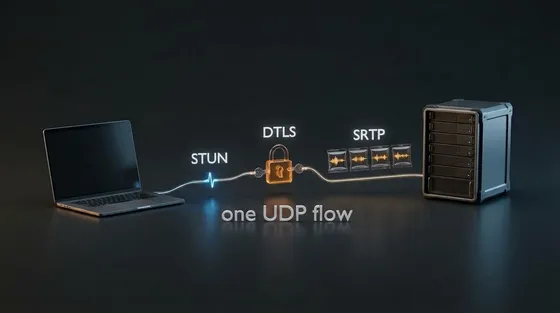
The path is found, and every router on it could hand Alice's voice to a decoder. How two machines that have never met agree on keys over a network anyone can read, what SRTP does to her packet and what it deliberately leaves alone, and how long a call takes from cold start, measured.
How a voice call actually works, one layer at a time.
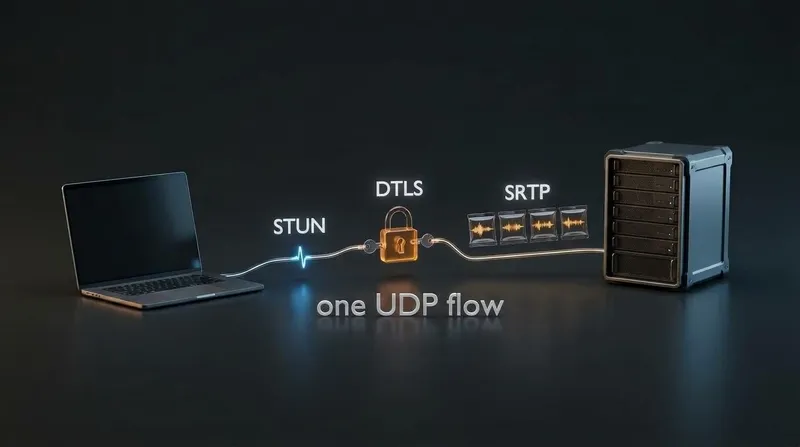
The path is found, and every router on it could hand Alice's voice to a decoder. How two machines that have never met agree on keys over a network anyone can read, what SRTP does to her packet and what it deliberately leaves alone, and how long a call takes from cold start, measured.
How a voice call actually works, one layer at a time.

