When the user changes their mind mid-task
Stopping the agent doesn't stop what it already sent. Secure the new plan, then undo the old one.
On this page · 12 sections
- The assistant on hold
- Four things a revision has to keep apart
- Reading the revision
- Stopping the wait doesn’t stop the work
- Closing the key
- Keys name the operation, not the attempt
- Or wait for the call to finish
- Secure the replacement, then undo the old
- Undoing is a new action, not a rollback
- A crash in the middle
- What the history says, and what the user hears
- The contract each tool needs
- The demo
You’ve asked your agent to book dinner for four on Friday at 19:00, and to text the group, the friends you’re eating with, once the table is confirmed. The agent’s runtime, the code around the model that calls tools and keeps the history, has sent the booking request to the restaurant’s system and is waiting for the reply. Before it arrives, you write: “actually, Saturday”.
The obvious move is to stop what the agent is doing and start again with the new plan. Here’s what that does, in the small runtime from the previous article. R1 and R2 are the restaurant’s first and second reservations:
-- restaurant holds: R1 (Fri 19:00), R2 (Sat 19:00)-- group received: 'table for 4, Sat 19:00'-- agent's last message: Booked Sat 19:00 for 4 (R2). Texted group.Two tables, and the agent reports success. Worse, its history, the only account of the work it will ever read, never mentions the Friday table, so nothing will ever cancel it. You changed your mind; the world didn’t. The Friday request had already reached the restaurant. I’ll show what a runtime has to do instead, one failure at a time, with the same booking all the way through.
The short version
- Stopping the agent stops it waiting for the restaurant. It doesn’t stop the restaurant. A request already sent is in doubt until the agent finds out what happened to it.
- So ask the restaurant whether Friday went through, and tell it to refuse that request if it turns up late. If the service can’t be asked, wait for its reply instead.
- Give each booking its own ID, so the restaurant never confuses Saturday with Friday.
- Book Saturday first, then cancel Friday. The other order can leave you with no table at all.
- Write each request down before sending it, so a crash in the middle can be recovered without booking twice.
- Then tell you, and the agent’s own history, what happened to Friday.
The assistant on hold
Think of a personal assistant on hold with the restaurant, booking Friday, when you lean over and say “actually, make it Saturday”. A careless assistant hangs up and calls back about Saturday, and you end up with two tables. A good one asks the restaurant first: did that Friday booking go through? Then they book Saturday, and only once Saturday is confirmed, cancel Friday. And they tell you about both.
That’s the whole procedure, and the rest is how a runtime does each part when the “restaurant” is an API and the “assistant” is code.
Every run here comes from the previous article’s runtime, where a scripted model reads each phrase into a fixed result, so every difference between two runs comes from the runtime’s rules. In its logs, T1 is the first turn, one round of plan, act and reply, A1 the first consent request, and ... marks lines left out. IDs restart in each run, so R1 is whichever table that run booked first.
Four things a revision has to keep apart
A revision touches four different things, and they change at different moments:
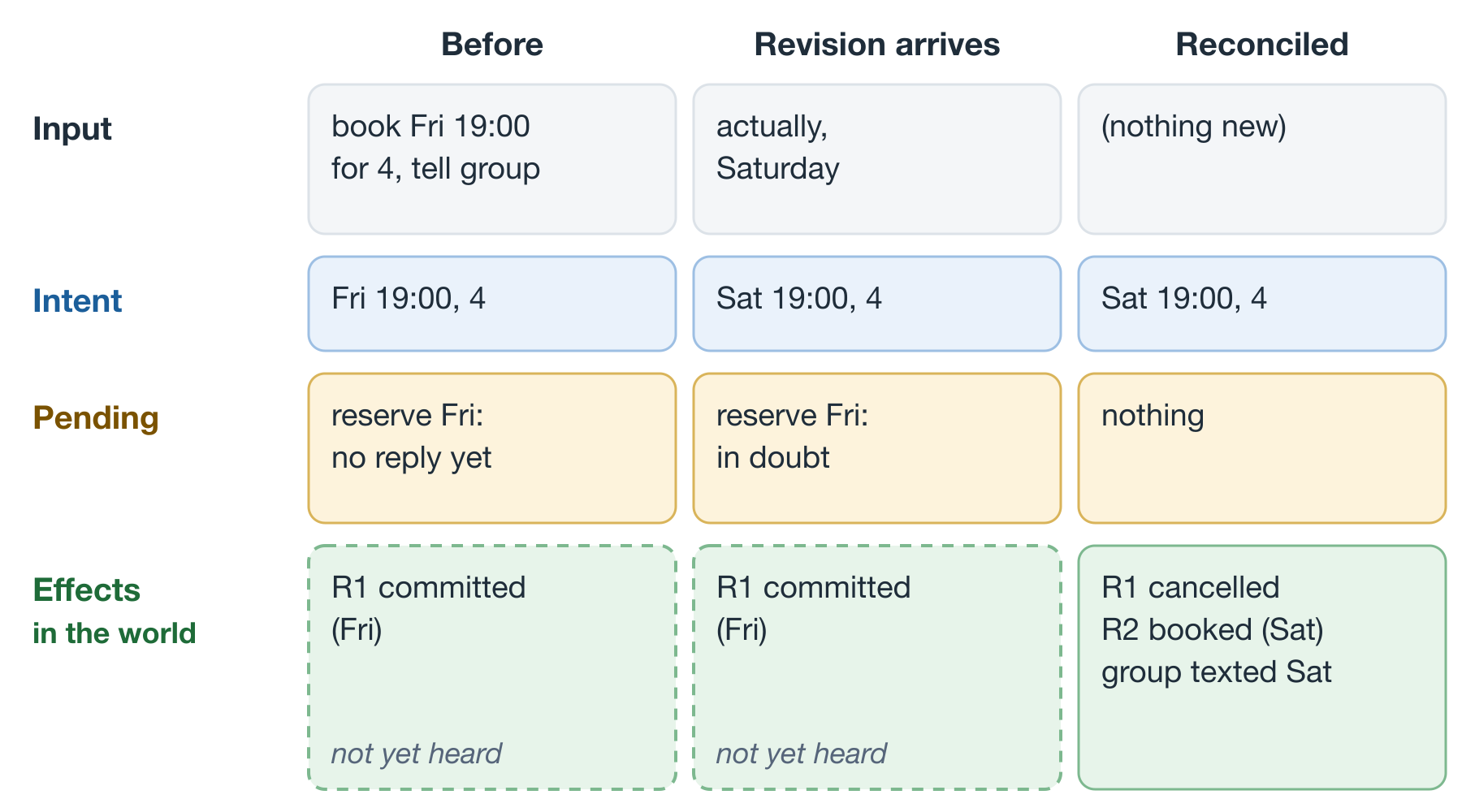
The runtime can’t see the bottom row directly. It only learns what happened in the world from replies, lookups and receipts. So the third row, pending, what it has sent without hearing back, decides its next move. A revision is reconciled once the runtime’s records and plan agree with the world again.
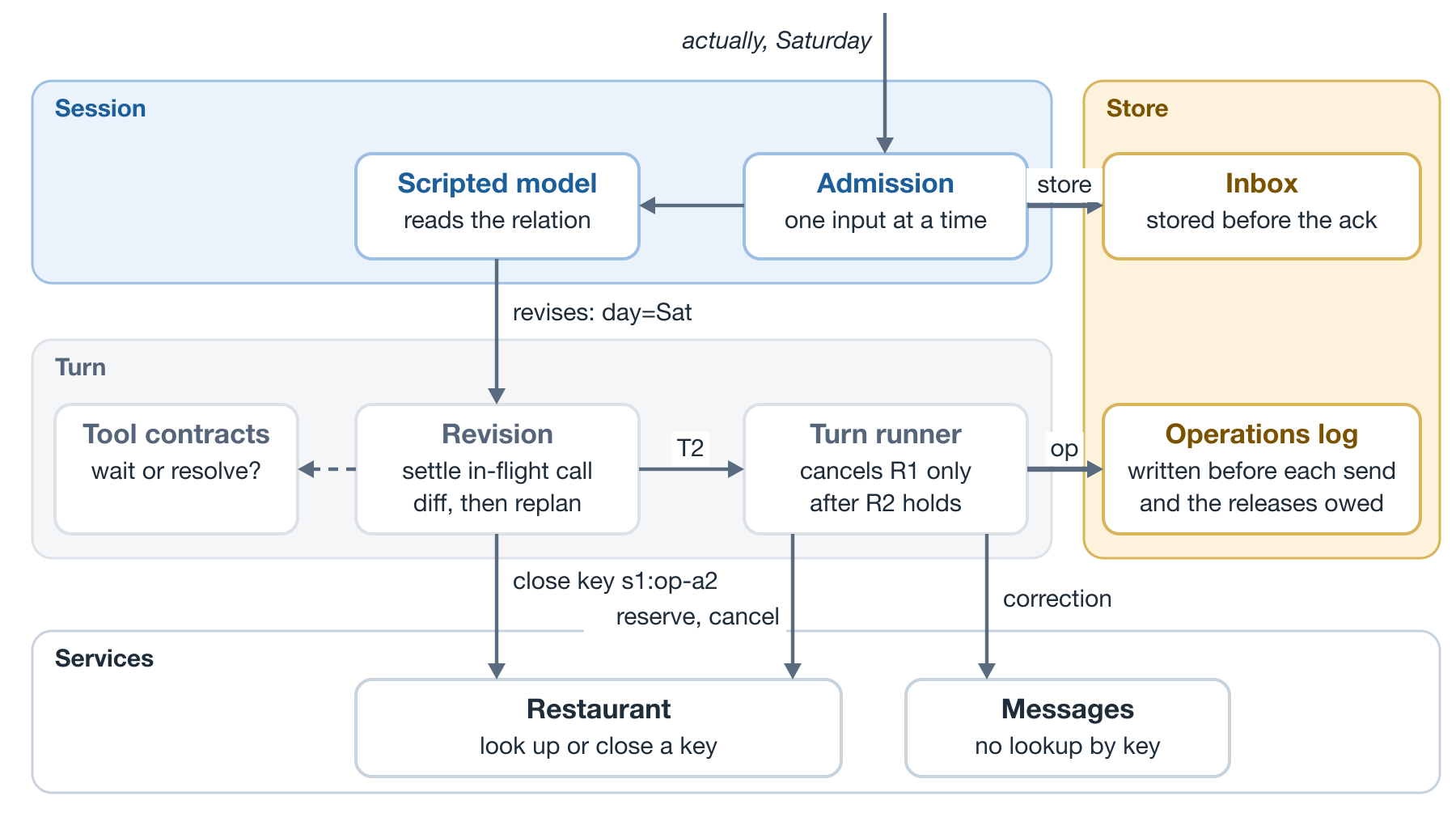
Those rows live in different parts of the runtime. The figure names them, and each one comes up below:
Reading the revision
First the runtime has to know what “actually, Saturday” means. The model turns it into a structured revision of the running turn, revises T1: day=Sat. The runtime can’t catch a misreading; it acts on whatever the model reports. But for something unclear, like “Saturday too?”, which the model marks unsure, the runtime lets the call in flight finish and asks: “Do you mean Sat instead of Fri, or as well?”
With the new intent known, the runtime compares every booking the old turn holds against it:
if op.step == "reserve_table" and op.state == "committed": op.release = False if self._matches(op.args, new): kept.append(op.id)... else: op.release = True release.append(op.id)... @staticmethod def _matches(args, intent): return (args["day"], args["time"], args["party"]) == (intent.day, intent.time, intent.party)A booking that still matches the new intent is kept. One that doesn’t is marked for release: it will be cancelled once its replacement holds, not now. “Actually, make it 20:00” doesn’t match R1, so R1 is released and 20:00 is booked. “Actually, just tell Sam, not the group” does match, so R1 is kept and the new plan skips booking altogether. What counts as “the same booking” is _matches: add a field there, and every revision compares it.
Stopping the wait doesn’t stop the work
In the run at the top, the revision stopped the code that was waiting for the restaurant’s reply, and the log says so:
5 tool.sent T1 reserve_table(Fri, 19:00, 4) key=s1:op-a26 restaurant committed R1 Fri 19:00 x47 input user: actually, Saturday8 model.read revises T1: day=Sat9 tool.cancelled T1 reserve_table: stopped waitingLine 9 claims a cancellation the runtime has no evidence for. The restaurant committed R1 at line 6. None of the usual stop buttons reach the restaurant:
- Cancelling a Python asyncio task only arranges for a
CancelledError“to be thrown into the wrapped coroutine”: it stops your code. - OpenAI’s mid-turn steering “does not rewrite output already sent to your application, undo earlier actions, or cancel tools that have already started”.
Both stop the agent’s own work. The table stays booked. In the assistant’s terms, putting the phone down doesn’t undo what the restaurant already wrote in its book. So the reconciled runtime records the same moment differently. When a revision stops the wait, it marks any call that has an effect on the world as unknown, not cancelled:
except asyncio.CancelledError: if not self.dead: op.state = "unknown" if self.reconcile and c.effect != "none" else "cancelled" self.tl.add("tool." + op.state, f"{op.turn} {op.step}: stopped waiting") raisereconcile=False is the run at the top. (The previous article’s restart logged tool.unknown at this point because it had this switch on; the run at the top turns it off.) With it on, a call with an effect is in doubt (unknown in the code and logs) until something resolves it. A pure read, like checking availability, has effect="none" and can simply be dropped.
The model API adds a rule of its own here
Anthropic’s tool-use documentation says “Tool result blocks must immediately follow their corresponding tool use blocks”. So the user’s revision can’t be added to the history until the open call has a result, and at that moment the only honest result is “in doubt”. The demo’s history meets the rule because, as the last section shows, it records each result right after its own call, where its effect happened, and only then the revision.
Closing the key
Every booking request carries an idempotency key, key= in the logs: an ID that lets the restaurant perform the request at most once, however many times it arrives. Here it’s s1:op-a2, session s1, operation op-a2. The restaurant can say, by key, whether a request landed, and the runtime asks it when it resolves an in-doubt call:
def _resolve(self, op): c = self.contracts[op.step] if c.lookup and op.key: if c.fence and self.fencing: rid = self.restaurant.close(op.key) self.tl.add("resolve", f"{op.key}: {rid or 'nothing has landed'}; key closed") else: rid = self.restaurant.lookup(op.key) self.tl.add("resolve", f"{op.key}: {rid or 'nothing has landed'}")...There are two ways to ask. lookup just asks “did this key land?”. close asks the same and, in one step, tells the restaurant to refuse that key from now on: the assistant adding “and if a Friday request from me turns up later, ignore it”. fence in the tool’s contract says the restaurant supports closing, and fencing is the runtime’s switch for using it. The difference matters because a lookup that finds nothing only proves the request hasn’t landed yet. Requests can be delayed in the network.
Try it. Choose Reconciles with the restaurant first, then Is delayed in the network, and compare closing the key with only looking it up. (In the delayed runs Saturday is booked first, so it’s R1, and the late Friday is R2.)
This lab runs a real call in your browser, so it needs JavaScript.
With only a lookup, the runtime finds nothing, books Saturday, and then Friday lands anyway: two tables. With the key closed, the late request gets refused a late request: key s1:op-a2 is closed, and the restaurant ends with only Saturday:
The close turns the late Friday request into a refusal; a lookup alone would have let it commit.
It only works if the restaurant records the key and the booking together, so no request can slip in between checking a key and closing it. Without a close, the fallback is time: keep the call in doubt until a deadline the service enforces has passed.
Here’s the undelayed revision done right, from start to finish:
The runtime finds R1 before it books Saturday, and cancels R1 only after R2 holds, so the restaurant ends with one table.
Where this idea comes from, and why ordinary idempotency isn't enough
Closing a key is related to a fencing token, where the storage side “remembers that it has already processed a write with a higher token number… and so it rejects the request”. Both let the service refuse a request that arrives too late to be wanted.
Idempotency keys as services usually offer them are built for retries, not for this. Stripe’s idempotency docs describe its v1 API: a retried key gets the saved result back, and a key it has never seen is simply run as a new request. That’s right for a retry. After a revision it’s wrong, because the late Friday request carries a key the service has never seen, so it runs and books Friday.
Keys name the operation, not the attempt
The previous article showed a key that’s too fine: built from the turn, so a restart got a new key and booked twice. The opposite mistake is a key that’s too coarse, built from the step name alone, s1:reserve_table: the assistant filing everything under “my booking”. Then Friday and Saturday share a key. On a server that can look keys up but not close them, and replays by key without checking the request’s details, the Saturday request just gets Friday’s result back. And because the runtime then compensates for the old booking, undoing it by cancelling it, it cancels the only table there is:
17 tool.sent T2 reserve_table(Sat, 19:00, 4) key=s1:reserve_table18 restaurant replayed R1 for key s1:reserve_table19 tool.result T2 reserve_table -> R120 compensate R1: the replacement holds ...22 restaurant cancelled R1 ...-- restaurant holds: nothingThe runtime records the result as Saturday, then cancels “the old Friday booking”, R1, which is the same table. A server that does compare details, as Stripe’s does (“errors if they’re not the same”), turns this into a visible KeyMismatch, and the runtime keeps Friday and asks (key-reuse-strict). A cheap guard, which the demo doesn’t have, would catch it too: never cancel a booking whose ID the replacement just returned.
So the key names the operation: a booking whose details haven’t changed keeps its key and is never sent twice, and Saturday is a new operation with a new key, s1:op-a4.
Or wait for the call to finish
Resolving by key needs a service that can be asked. When it can’t, the runtime can let the call finish, stop at the next step, and work with an outcome it knows. The cost is that the revision waits for the slowest call in flight. The choice is per tool, in its contract:
CONTRACTS = { # A read. Safe to drop mid-flight here; a read that places a hold would not be. "check_availability": Contract(effect="none", needs_consent=False), "reserve_table": Contract(effect="reversible", needs_consent=True, keyed=True, lookup=True, fence=True, undo="cancel_reservation"), # No lookup, so a revision waits for the delivery receipt, up to a bound (50 ms in the demo). "text_group": Contract(effect="irreversible", needs_consent=True, wait=0.05), # Irreversible: a released table can be taken by someone else. Acts for the user, so a # turn the user didn't start must ask; a fee needs the user's consent whoever started it. "cancel_reservation": Contract(effect="irreversible", needs_consent=True), ...}Read each line as what the runtime may assume about that tool. Checking availability has no effect, so dropping it is free. Reserving is reversible, keyed, can be looked up and closed, and its undo is cancel_reservation. The group text can’t be looked up or undone, so a revision waits up to 50 ms for its delivery receipt.
When the receipt comes in time, the runtime knows the Friday text went out and plans a correction. When it doesn’t, the runtime treats the text as sent and tells the user “I couldn’t confirm it, so I’ve treated it as sent”. Assuming delivery is safe here because a “change of plan” text to people who never saw the first plan is merely odd.
Messages that overtake each other, and payments
A correction can also overtake a delayed original, so the group reads Saturday and then Friday. The receipt wait can’t prevent that, since it has just expired. The order has to come from the channel, or from a reference in the correction that the recipient’s app can order by; otherwise the risk has to be accepted and stated, as the demo does. For a payment, a double correction isn’t harmless, so an unconfirmed charge needs its own rule, or a question.
Secure the replacement, then undo the old
With R1 confirmed and no longer wanted, the runtime has to choose what to do first. Cancel Friday first and then try Saturday, and if Saturday is full the user is left with nothing. So the default is the other order: the releases wait in the new turn’s release list, and the runtime works through them only after the new booking succeeds. If Saturday is full, R1 comes off the list, and you’re asked: “You still hold R1 (Fri 19:00); keep it, or shall I cancel it?”
Try both orders with Saturday full:
This lab runs a real call in your browser, so it needs JavaScript.
Securing first means holding two bookings for a while. Where that costs money or blocks something, like a payment hold against a card limit, releasing first is the better order, and the user should hear so before the runtime acts.
Undoing is a new action, not a rollback
Cancelling R1 isn’t rewinding time. It’s a new action with its own contract, its own cost and its own ways to fail. The saga pattern, the standard name for this, says “a developer must design compensating transactions that explicitly undo changes made earlier”. Here the compensation for a booking is a cancellation, and inside the restaurant’s cancellation window it costs a fee. The runtime asks before paying it, even though the user started the turn, and the approval is bound to the amount:
20 compensate.ask cancelling R1 costs a 20 fee: A1 needs the user's consent ...25 input user: yes26 approval A1: runs exactly its 1 step(s) ...28 tool.sent T3 cancel_reservation(R1, 20)29 restaurant cancelled R1 (fee 20)The other ways it can go:
| What happens | What the runtime does |
|---|---|
| The fee rises to 80 before the yes arrives | The restaurant refuses to cancel above the approved 20, and the runtime asks again for 80 |
| The user says “no, keep it” | R1 is kept |
| The restaurant refuses outright | The user is left holding both tables, and the runtime says exactly that |
| The turn is revised again before the user answers | The request was asked under the old plan, so it’s voided, and asked again if the new plan still releases the table |
The hardest case is a booking service with no keys and no lookup, and a reply that never comes. The runtime can’t cancel a reservation it has no ID for, and can’t know whether it exists. It books Saturday, records Friday’s outcome as unknown, and tells the user what to watch for:
-- agent's last message: I may have booked Fri 19:00: the restaurant never confirmed, and I can't check. If a confirmation arrives, tell me and I'll cancel it. Booked Sat 19:00 for 4 (R2). Texted group.A crash in the middle
Everything so far happens in one process. Now kill it at the worst moment: after the restaurant commits Saturday but before the runtime hears about it. A new process starts, reading the same store, the database the runtime writes its records to. What the new process can do depends on what was written there before the requests went out: in the assistant’s terms, whatever they wrote on their notepad before picking up the phone. The runtime writes down two things:
- each operation, with its key, before its request is sent (the
_opmethod from the previous article); - the running turn’s record: what it’s trying to do, and the releases it still owes, such as “cancel R1 once Saturday holds”.
def _write_turn(self, turn): """The running turn's record: what a new process needs to resume it.""" self.store.turn = {"id": turn.id, "origin": turn.origin, "intent": turn.intent, "fixed": turn.fixed, "correction": turn.correction, "release": turn.release, "kept": turn.kept, "facts": turn.facts}The record’s fields are the turn’s ID and origin, its intent and fixed steps, any correction it owes the group, the releases and kept bookings, and the facts it will report. With both records kept, the new process runs recover(): it resolves every call the log shows in flight, by key where the contract allows, then resumes the turn from its record, with the operations that belong to it (own).
async def recover(self): """A new process, same store: resolve what was in flight, resume the turn, then replay any input that was acknowledged but not yet acted on.""" self.tl.add("restart", f"{len(self.store.ops)} operation(s) in the log") for op in list(self.store.ops.values()): if op.state in ("sent", "unknown"): self._resolve(op) rec = self.store.turn if rec is not None: own = [op for op in self.store.ops.values() if op.turn == rec["id"]]...The Saturday booking comes back as skip reserve_table: op-a4 already committed as R2, R1 is cancelled, and the restaurant holds one table.
Now suppose the store kept the turn but not the operations: a design that saves the conversation between steps, but not the calls it has in flight. Try both:
This lab runs a real call in your browser, so it needs JavaScript.
With no record of the operations, the resumed turn doesn’t know Saturday was already booked as R2, so it books Saturday again, as R3, under a fresh key. And the release it owes points at a Friday operation that no longer exists, so R1 is never cancelled. Three tables: R1, R2 and R3.
The patterns this is, and a crash during the text
Writing the record before the request is the transactional outbox pattern (“first store the message in the database as part of the transaction”). Resuming from that log is what durable execution engines such as Temporal do: they persist each step so a workflow resumes after a crash.
A crash while the Saturday text or the Friday cancellation is in flight doesn’t send either again. The log shows the call as sent, and a sent call with no lookup is treated as done rather than repeated; the user is told it wasn’t confirmed (crash-during-text, crash-during-cancel).
What the history says, and what the user hears
Last, the agent’s own memory, the assistant’s diary. After a reconciled revision where the Friday text had already gone out, the history the model sees reads:
user: book Friday 19:00 for 4 and tell the grouptool: Fri 19:00 for 4: availabletool: booked R1 (Fri 19:00 for 4)tool: texted group: 'table for 4, Fri 19:00'user: actually, Saturdaytool: Sat 19:00 for 4: availabletool: booked R2 (Sat 19:00 for 4)tool: cancelled R1tool: texted group: 'Change of plan: table for 4, Sat 19:00'assistant: The earlier text had already gone out. Booked Sat 19:00 for 4 (R2). Cancelled R1 (Fri 19:00). Texted group a correction.Three rules made it read like that:
- It keeps the user’s own words, including the revision.
- Records of effects are never removed. A revision adds resolutions, cancellations and corrections; it doesn’t erase “booked R1”.
- Each record sits where its effect happened. The Friday text’s receipt arrived after “actually, Saturday”, while the revision was waiting for it, yet its record sits before the revision, because that’s when the group got the text.
That last rule has a cost: writing into the past breaks a prompt cache from that point, since “Cache hits require 100% identical prompt segments”. The alternative is to append a record that says when the effect happened, which keeps the cache at the price of a less direct story. Either way, if the history is ever summarised to save space, the summary must not drop “booked R1”, or the next turn inherits the blind spot of the run at the top.
And the last line is what the user hears: what the records say, including that the Friday text had already gone out.
The contract each tool needs
Every tool call in this runtime moves through the same states, and every way out of “in doubt” needs something from the service or the contract:
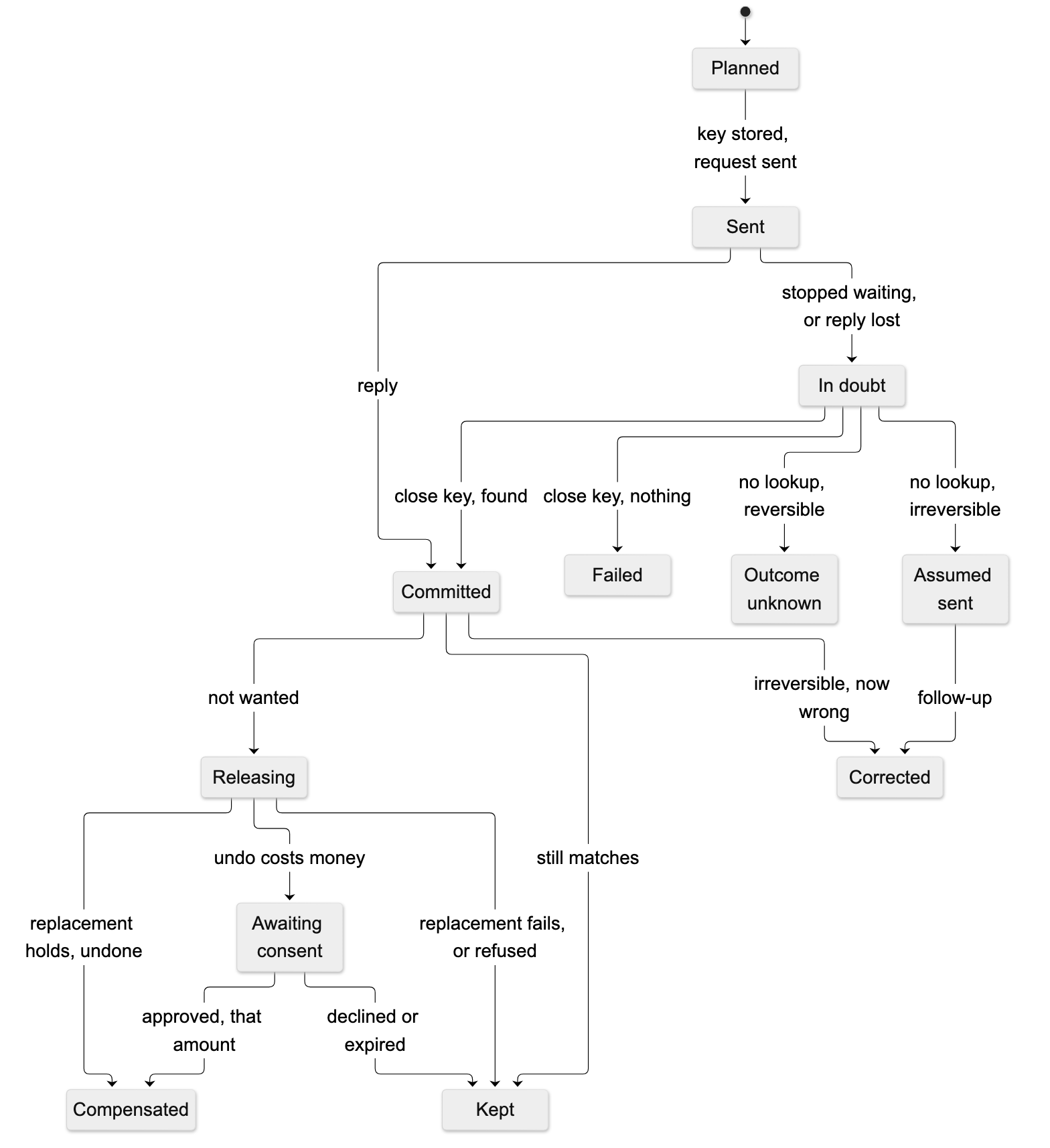
So for every tool your agent can call, write down:
- Its effect: none, reversible, or irreversible. A read that places a hold has an effect.
- How to undo or correct it: the compensating action, with its cost, cut-off and refusal cases, and which costs need the user’s consent, bound to the amount.
- What the service offers for calls in doubt: idempotency keys, a lookup by key, a way to close a key, a deadline after which requests are refused, and how long keys are kept.
- What a revision does while the call is in flight: stop and resolve it, or wait, and for how long.
- Which order to use: secure the replacement first or release first, and why.
- What the history and the user are told in each state, including “treated as sent” and “outcome unknown”.
Then store each operation, and each release owed, before the request that depends on it.
The demo
It’s the same runtime as the previous article’s, in turn-without-the-user/. Every log here is one scenario’s output, and its README maps each section to its scenarios.
cd mainlog-code/turn-without-the-userpython -m agent_runtime.demo revise-in-flight-naive # the run at the toppython -m agent_runtime.demo revise-in-flight # the same revision, reconciledpython -m agent_runtime.demo revise-after-text --historypython -m pip install pytest && python -m pytest testsIt shows each rule in one process and isn’t hardened: its README lists what it doesn’t do, starting with durability, which is simulated by a Python object standing in for a database.
The run at the top ended with two tables and a history that never mentions Friday. With the contract filled in, the agent finds out what happened to Friday before it books Saturday, undoes it only once Saturday holds, and says so, in its history and to the user.
Related posts

The agent event bus
When one agent calls another with a sentence, the caller's model writes the callee's prompt, and a stranger's note can ride along. In a small scripted demo a bus seemed to fix that, but a typed fact sent by call was just as safe, and a bus event with a note was not. What the bus adds is that one agent being down doesn't leave another's work half done.
AI & agentic architecturesai-agentsarchitecturedistributed-systems
Diagrams worth reading
My agent could already write Mermaid. Diagrams worth reading took a skill that chooses the picture, keeps the facts intact, and checks the drawing before handing it back.
AI & agentic architecturesai-agentsarchitecture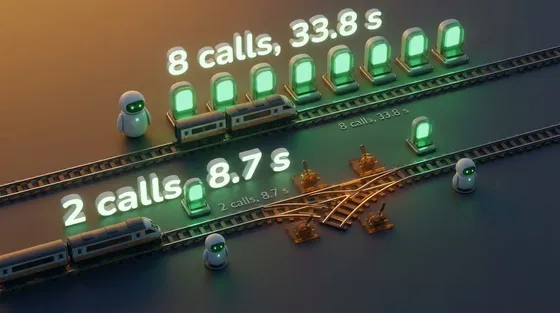
What a state machine buys an agent
The same dinner booking, sent to Claude as a free-form tool loop and as a state machine. Per-state tool lists sent 61% fewer tokens, but with prompt caching on they cost 23% more on input, and with output counted the two came out about even. The real saving was code running the steps that need no model, 8 calls down to 2 and about 72% off the total, plus a table of every state against every event.
AI & agentic architecturesai-agentsprompt-engineeringarchitecture
 AI
The agent event bus
When one agent calls another with a sentence, the caller's model writes the callee's prompt, and a stranger's note can ride along. In a small scripted demo a bus seemed to fix that, but a typed fact sent by call was just as safe, and a bus event with a note was not. What the bus adds is that one agent being down doesn't leave another's work half done.
ai-agentsarchitectureSep 2026 AI
Diagrams worth reading
My agent could already write Mermaid. Diagrams worth reading took a skill that chooses the picture, keeps the facts intact, and checks the drawing before handing it back.
ai-agentsarchitectureSep 2026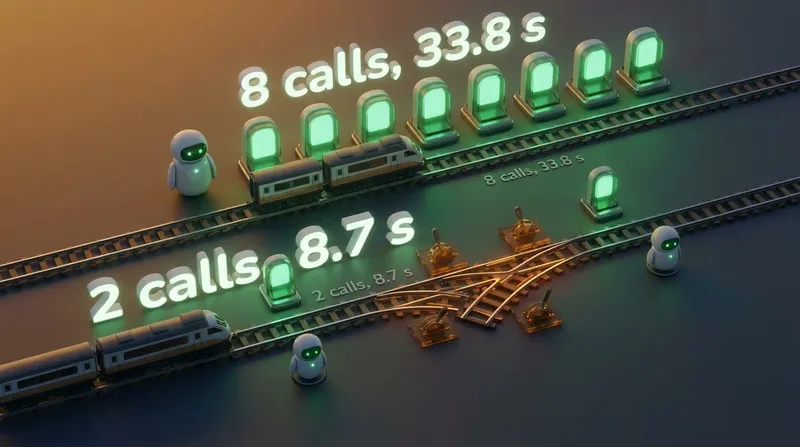 AI
What a state machine buys an agent
The same dinner booking, sent to Claude as a free-form tool loop and as a state machine. Per-state tool lists sent 61% fewer tokens, but with prompt caching on they cost 23% more on input, and with output counted the two came out about even. The real saving was code running the steps that need no model, 8 calls down to 2 and about 72% off the total, plus a table of every state against every event.
ai-agentsprompt-engineeringOct 2026
Comments