Call topology cost
/tools/call-topology-cost/Pick a call size and see where a voice call's cost lands for mesh, an SFU, an MCU and a server that is the other peer, with real packet sizes, and what would make it cheaper.
Pick a call size and see where a voice call's cost lands for mesh, an SFU, an MCU and a server that is the other peer, with real packet sizes, and what would make it cheaper.
Add people to a voice call and someone has to copy each voice for every listener. Where that copy is made decides what the call costs, and who pays:
| Pattern | Who makes the copies | What grows with the number of people, N |
|---|---|---|
| Mesh | Every client, for every other client | Each client sends N-1 streams and receives N-1 |
| SFU (selective forwarding) | A server that forwards packets without decoding them | The server sends N(N-1) streams, or K(N-1) if it forwards only the K loudest |
| MCU (mixer) | A server that decodes everyone, mixes, and encodes one mix per listener | N decodes, N mixes and N encodes on the server, every frame |
| Server is the peer | Nobody: one user talks to one service | One stream each way, per user |
Pick the number of participants and the tool compares all four side by side: each client’s upload and download, the server’s traffic in and out, and the server’s operations every frame. The pattern you pick is drawn as a picture of its streams, and gets its own list of changes that would make it cheaper.
Say you are planning a ten-person stand-up on an SFU, and want the server’s bandwidth with the packets a browser really sends, not the bare 120 B.
1. Enter it.
| Input | You enter | Why |
|---|---|---|
| Participants | 10 | Everyone on the call |
| Draw the traffic for | SFU | The pattern you are planning |
| Codec | Opus at 32 kb/s, 20 ms frames | The default voice stream |
| Packet | SRTP and post 4’s two extensions, over IPv4 | Every WebRTC packet is encrypted, and post 4’s offer asks for the audio level and the MID |
2. Press Run, and read the comparison. All four patterns, in kb/s. The client columns are one device; the server columns are the whole call.
| Pattern | Client up | Client down | Server in | Server out |
|---|---|---|---|---|
| Mesh | 496.8 | 496.8 | none | none |
| SFU (picked) | 55.2 | 496.8 | 552 | 4968 |
| MCU | 55.2 | 55.2 | 552 | 552 |
| Peer, per user | 55.2 | 55.2 | 55.2 | 55.2 |
3. Read the picture. The SFU you picked, as streams: 10 clients --10 x 55.2 kb/s--> SFU --90 x 55.2 kb/s--> 10 clients,
the SFU forwarding without decoding and each listener hearing 9 voices.
4. Read what would make it cheaper.
| Change | What it saves | What it costs |
|---|---|---|
| Forward only the 3 loudest | The server’s output falls from 4968 to 1490.4 kb/s, each listener’s from 496.8 to 165.6. | Quieter voices are not heard while three others are louder. Senders must write the audio level. |
| Send 40 ms frames | Each stream falls from 55.2 to 43.6 kb/s, because the headers are sent half as often. | 20 ms more delay, and each lost packet takes 40 ms of sound. |
In plain words: the server’s 5 Mb/s comes from copying every voice to nine listeners. Forwarding only the three loudest cuts it by more than two thirds, and a speaker picker needs nothing but the one byte of loudness each sender already writes.
5. Read the server’s work and the packet. Server operations every 20 ms frame puts them in named columns: the SFU does 10 decrypts and 90 encrypts; the MCU does 10 of each. One stream adds that the SFU sends 4500 packets a second. One packet, at the bottom, itemises the 138 B: 80 B of sound, 12 B RTP, 8 B UDP, 20 B IPv4, 10 B SRTP tag, 8 B of header extensions. Headers are 58 B of every 138, which is why longer frames help. Pick AES-GCM and four extensions, over IPv6 and the same packet is 172 B, 92 of them headers, and the server sends 6192 kb/s.
BE DE and a length), then one byte of ID
and length per extension plus its data, padded to a multiple of 4. The data is 1 byte for the audio level
(RFC 6464), 1 for a MID of 0 (RFC 8843), 2 for a transport-wide sequence number and 3 for abs-send-time. So the
audio level alone is 8 B, adding the MID still 8, adding the sequence number 12, and adding abs-send-time 16.index.ts/** * Call topology cost: where the work of a voice call lands for mesh, an SFU, an MCU, and a server that is simply the * other end of the call. * * The arithmetic is post 6's demo, `topology_cost.py`, and the fixtures are its output. Every number is a count of * streams times one stream's rate, so nothing here is measured and nothing is estimated: * * - one packet is the codec payload (bitrate x frame / 8), plus 12 B of RTP (RFC 3550), 8 of UDP and 20 of IPv4 or * 40 of IPv6 (RFC 8200's fixed header), plus the SRTP authentication tag (10 B for AES_CM_128_HMAC_SHA1_80, RFC * 3711; 16 B for AEAD_AES_128_GCM, RFC 7714) and any RTP header extensions, in RFC 8285's one-byte form; * - mesh sends every voice N-1 times from the client; an SFU receives N and sends K(N-1), K being the streams it * forwards; an MCU receives N and sends N mixes, each leaving out its listener's own voice (RFC 7667 section * 3.6.1); the server that is the other peer is one stream each way, per user. * * Assumptions, each a choice the README states: everyone talks all the time (no DTX), mesh runs one encoder per * connection as RFC 7667 section 3.4 draws it, and the peer server talks back while the user talks. */import type { Cell, Output, Tool } from "@toolbench/sdk";
type Input = { participants: number; pattern: string; loudest: number; codec?: string; bitrate: number; frame: string; packet?: string; ip?: string; srtp: string; ext?: string;};
class InputError extends Error { readonly input: string; constructor(message: string, input: string) { super(message); this.input = input; }}
const RTP_B = 12;const UDP_B = 8;const IP_B: Record<string, number> = { "4": 20, "6": 40 };
/** * Header extensions, each as the bytes of data its element carries. In RFC 8285's one-byte form every element is one * byte of ID and length plus its data, after a 4-byte header (0xBEDE and a length), padded to a multiple of 4 bytes: * the audio level is 1 byte of data (RFC 6464), the MID "0" 1, a transport-wide sequence number 2, abs-send-time 3. */const EXTENSIONS: Record<string, { label: string; data: number[] }> = { none: { label: "no header extensions", data: [] }, level: { label: "the audio level", data: [1] }, "level-mid": { label: "the audio level and the MID", data: [1, 1] }, "level-mid-twcc": { label: "the audio level, the MID and a transport-wide sequence number", data: [1, 1, 2] }, "level-mid-twcc-abs": { label: "the audio level, the MID, a transport-wide sequence number and abs-send-time", data: [1, 1, 2, 3] },};
/** Bytes on the wire for a set of one-byte-form extensions: none at all, or the 4-byte header, the elements, and padding. */export function extensionBytes(data: number[]): number { if (data.length === 0) return 0; const raw = 4 + data.reduce((sum, d) => sum + 1 + d, 0); return Math.ceil(raw / 4) * 4;}
type Ops = { unprotect: number; decode: number; mix: number; encode: number; protect: number };type Row = { key: string; name: string; up: number; down: number; serverIn: number | null; serverOut: number | null; server: Ops | null; grows: string };
/** kb/s with no trailing noise: 48, 55.2, 4320. */const kb = (x: number) => String(Math.round(x * 100) / 100);const plural = (n: number, one: string, many = `${one}s`) => `${n} ${n === 1 ? one : many}`;
export function rows(n: number, k: number): Row[] { const fwd = Math.min(k, n - 1); return [ { key: "mesh", name: "Mesh", up: n - 1, down: n - 1, serverIn: null, serverOut: null, server: null, grows: "N-1 streams up from every client" }, { key: "sfu", name: k < n ? `SFU, ${k} loudest` : "SFU", up: 1, down: fwd, serverIn: n, // Each of the K forwarded speakers gets the other K-1, everyone else gets K: K(K-1) + (N-K)K = K(N-1). serverOut: k * (n - 1), server: { unprotect: n, decode: 0, mix: 0, encode: 0, protect: k * (n - 1) }, grows: k < n ? "K(N-1) streams out of the server" : "N(N-1) streams out of the server", }, { key: "mcu", name: "MCU", up: 1, down: 1, serverIn: n, serverOut: n, server: { unprotect: n, decode: n, mix: n > 2 ? n : 0, encode: n, protect: n }, grows: "N decodes, mixes and encodes on the server" }, { key: "peer", name: "Server is the peer", up: 1, down: 1, serverIn: 1, serverOut: 1, server: { unprotect: 1, decode: 1, mix: 0, encode: 1, protect: 1 }, grows: "one stream each way, per user" }, ];}
export default { run(input: Input) { try { const n = Number(input.participants); if (!Number.isInteger(n) || n < 2) throw new InputError("A call needs at least 2 participants.", "participants"); if (n > 50) throw new InputError("At most 50 participants.", "participants"); const bitrate = Number(input.bitrate); if (!Number.isInteger(bitrate) || bitrate < 6 || bitrate > 510) throw new InputError("The bitrate must be 6 to 510 kb/s, Opus's range (RFC 6716 section 2.1.1). G.711 is 64.", "bitrate"); const frame = Number(input.frame); if (![10, 20, 40, 60].includes(frame)) throw new InputError("Frames are 10, 20, 40 or 60 ms.", "frame"); if ((bitrate * frame) % 8 !== 0) throw new InputError("bitrate x frame length must be a whole number of bytes.", "bitrate"); const loudest = Number(input.loudest ?? 0); if (!Number.isInteger(loudest) || loudest < 0) throw new InputError("The number of loudest streams is a whole number, 0 for all.", "loudest"); if (loudest > n) throw new InputError("The loudest streams can be at most the number of participants.", "loudest"); const ipB = IP_B[input.ip ?? "4"]; if (ipB === undefined) throw new InputError("IP is version 4 or 6.", "ip"); const ext = EXTENSIONS[input.ext ?? "none"]; if (!ext) throw new InputError(`Header extensions must be one of ${Object.keys(EXTENSIONS).join(", ")}.`, "ext"); const tag = Number(input.srtp); const extB = extensionBytes(ext.data);
const payload = (bitrate * frame) / 8; const sizeAt = (ms: number) => (bitrate * ms) / 8 + RTP_B + UDP_B + ipB + tag + extB; const size = sizeAt(frame); const pps = 1000 / frame; const per = (size * 8 * pps) / 1000; const k = loudest === 0 ? n : loudest; const all = rows(n, k); const pick = all.find((r) => r.key === input.pattern) ?? all[1]!; const none: Cell = { text: "none", tone: "muted" }; const rate = (streams: number | null): Cell => (streams === null ? none : { text: kb(streams * per), mono: true });
/* * The answer is the comparison: the question is which pattern, so all four go first, in one frame. Client * columns are one device and server columns the whole call, which the caption says because the two scopes * sit side by side. The pattern the reader picked is named in words, not coloured: picking it is not a * judgement about it. */ const comparison: Output = { kind: "table", role: "comparison", caption: `${plural(n, "person", "people")}, everyone talking${k < n ? `, the SFU forwarding the ${k} loudest` : ""}. In kb/s: the client columns are one device, the server columns the whole call`, columns: [ { label: "Pattern", wrap: "prose", rowHeader: true }, { label: "Client up", align: "end", mono: true, wrap: "none" }, { label: "Client down", align: "end", mono: true, wrap: "none" }, { label: "Server in", align: "end", mono: true, wrap: "none" }, { label: "Server out", align: "end", mono: true, wrap: "none" }, ], rows: all.map((r): Cell[] => [ `${r.key === "peer" ? "Peer, per user" : r.name}${r.key === pick.key ? " (picked)" : ""}`, { text: kb(r.up * per), mono: true }, { text: kb(r.down * per), mono: true }, rate(r.serverIn), rate(r.serverOut), ]), };
/* * The picked pattern's streams, as counts of one stream's rate. Nodes are aggregates (all the clients, not * each one), so the picture stays three boxes at 50 people; the per-device figures are in the table above. */ const each = (count: number) => `${count} x ${kb(per)} kb/s`; const graph: Output = (() => { if (pick.key === "mesh") { return { kind: "graph", graph: { label: `Mesh, ${n} people: every device sends to every other`, spacing: "compact", nodes: [ { id: "talk", label: plural(n, "client"), note: `each sends ${plural(n - 1, "stream")}` }, { id: "hear", label: plural(n, "client"), note: `each receives ${n - 1}` }, ], edges: [{ from: "talk", to: "hear", label: each(n * (n - 1)) }], }, }; } if (pick.key === "peer") { return { kind: "graph", graph: { label: "The server is the other end: one stream each way, per user", spacing: "compact", nodes: [ { id: "user", label: "1 user" }, { id: "server", label: "Server", note: "decodes, then encodes its reply" }, ], edges: [ { from: "user", to: "server", label: each(1) }, { from: "server", to: "user", label: each(1) }, ], }, }; } const server = pick.key === "sfu" ? "SFU" : "MCU"; return { kind: "graph", graph: { label: `${pick.name}, ${n} people: every stream in and out of the server`, spacing: "compact", nodes: [ { id: "talk", label: plural(n, "client"), note: "talking" }, { id: "server", label: server, note: pick.key === "sfu" ? "forwards without decoding" : n > 2 ? "one mix per listener" : "decodes and re-encodes" }, { id: "hear", label: plural(n, "client"), note: pick.key === "mcu" ? (n > 2 ? "each hears one mix" : "each hears 1 voice") : `each hears ${plural(pick.down, "voice")}` }, ], edges: [ { from: "talk", to: "server", label: each(pick.serverIn!) }, { from: "server", to: "hear", label: pick.key === "mcu" && pick.server!.mix > 0 ? `${n} mixes x ${kb(per)} kb/s` : each(pick.serverOut!) }, ], }, }; })();
/* * What would make the picked pattern cheaper, each computed rather than asserted. Switching pattern is not * here: the comparison above already prices every switch. Sorted by the kb/s each takes off the busiest * flow, the server's output or a mesh device's upload, largest first. */ type Advice = { change: string; saves: number; gain: string; cost: string }; const advice: Advice[] = []; if (pick.key === "sfu" && k === n && n > 3) { const top = rows(n, 3)[1]!; advice.push({ change: "Forward only the 3 loudest", saves: (pick.serverOut! - top.serverOut!) * per, gain: `The server's output falls from ${kb(pick.serverOut! * per)} to ${kb(top.serverOut! * per)} kb/s, each listener's from ${kb(pick.down * per)} to ${kb(top.down * per)}.`, cost: "Quieter voices are not heard while three others are louder. Senders must write the audio level.", }); } if (frame < 60) { const longer = frame === 10 ? 20 : frame === 20 ? 40 : 60; const perLonger = (sizeAt(longer) * 8 * (1000 / longer)) / 1000; const streams = pick.serverOut ?? pick.up; advice.push({ change: `Send ${longer} ms frames`, saves: (per - perLonger) * streams, gain: `Each stream falls from ${kb(per)} to ${kb(perLonger)} kb/s, because the headers are sent ${longer === 2 * frame ? "half" : "two thirds"} as often.`, cost: `${longer - frame} ms more delay, and each lost packet takes ${longer} ms of sound.`, }); } advice.sort((x, y) => y.saves - x.saves);
/* * Server work, with the five operations as named columns rather than "3 / 0 / 0 / 0 / 6". Mesh has no * server, so it has no row. With the tag left out of the size, the crypto counts still stand: WebRTC always * encrypts, and the choice only changes what one packet weighs. */ const servers = all.filter((r) => r.server !== null); const work: Output = { kind: "table", role: "comparison", caption: `Server operations every ${frame} ms frame${tag === 0 ? ". Decrypts and encrypts assume SRTP, which WebRTC always uses, though the packet size here leaves out its tag" : ""}`, columns: [ { label: "Pattern", wrap: "prose", rowHeader: true }, { label: "Decrypt", align: "end", mono: true, wrap: "none" }, { label: "Decode", align: "end", mono: true, wrap: "none" }, { label: "Mix", align: "end", mono: true, wrap: "none" }, { label: "Encode", align: "end", mono: true, wrap: "none" }, { label: "Encrypt", align: "end", mono: true, wrap: "none" }, ], rows: servers.map((r): Cell[] => [ r.key === "peer" ? "Peer, per user" : r.name, { text: String(r.server!.unprotect), mono: true }, { text: String(r.server!.decode), mono: true }, { text: String(r.server!.mix), mono: true }, { text: String(r.server!.encode), mono: true }, { text: String(r.server!.protect), mono: true }, ]), };
const breakdown = [ `${payload} B of sound`, `${RTP_B} B RTP`, `${UDP_B} B UDP`, `${ipB} B IPv${input.ip ?? "4"}`, ...(tag ? [`${tag} B SRTP tag`] : []), ...(extB ? [`${extB} B of header extensions, for ${ext.label}`] : []), ]; const method: Output = { kind: "fields", role: "method", fields: [ { label: "One packet", value: `${size} B`, note: `${breakdown.join(", ")}.` }, { label: "One stream", value: `${kb(per)} kb/s`, note: `${pps} packets a second, so the server sends ${pick.serverOut === null ? "none" : kb(pick.serverOut * pps)} a second for the ${pick.key === "peer" ? "peer server, per user" : pick.name}.` }, { label: "Assumes", value: "Everyone talks all the time, with no silence suppression, so these are the busiest case.", mono: false }, ], };
const parts: Output[] = [ comparison, graph, ...(advice.length > 0 ? [ { kind: "table" as const, role: "actions", caption: `What would make the ${pick.key === "peer" ? "peer server" : pick.name} cheaper, largest saving first`, columns: [{ label: "Change" }, { label: "What it saves" }, { label: "What it costs" }], rows: advice.map((a): Cell[] => [a.change, a.gain, a.cost]), }, ] : []), work, method, ]; return { kind: "group", parts }; } catch (error) { if (error instanceof InputError) return { kind: "error", message: error.message, input: error.input }; throw error; } },} satisfies Tool<Input>;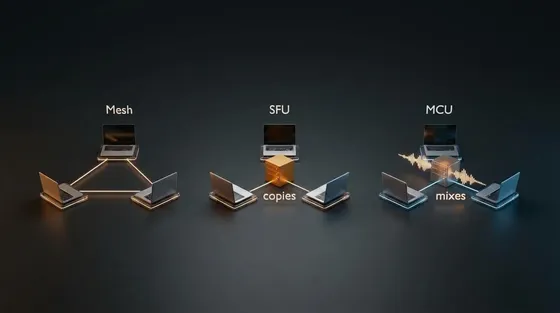
Add Bob and Carol to Alice's call and someone has to copy her voice twice. Mesh, an SFU and an MCU put that copy in three different places, and the cost moves with it: upload, server bandwidth, or a decode and an encode per person. Then back to Alice's assistant, where the server is simply the other end of the call.
How a voice call actually works, one layer at a time.
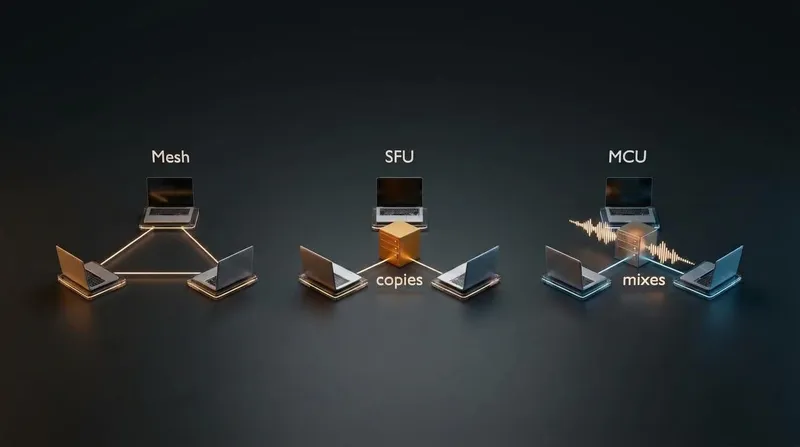
Add Bob and Carol to Alice's call and someone has to copy her voice twice. Mesh, an SFU and an MCU put that copy in three different places, and the cost moves with it: upload, server bandwidth, or a decode and an encode per person. Then back to Alice's assistant, where the server is simply the other end of the call.
How a voice call actually works, one layer at a time.

