Where the server sits
Mesh, SFU, MCU and the server that is the other end.
So far every call we’ve followed had two ends. At 9:17 AM in Paris, Alice talks to her assistant: her voice leaves as one packet every 20 ms (post 1), over the path ICE found (post 3), locked with keys only she and the assistant’s server hold (post 4), and the server reports back on how it’s arriving (post 5).
Later that morning she’s on a call with Bob and Carol, and she opens with “So the plan is to ship on Friday.” Now that sentence has two listeners. (Bob and Carol talk too, and their voices take exactly the same routes as hers, so we’ll follow Alice’s.) Every packet of her sentence has to reach Bob and Carol, so somebody has to make a second copy, and each copy has to be locked with a key its listener can open. Who makes that copy is the whole question. We’ll follow her sentence through the three answers, count what each one costs, and then go back to her assistant, where the server turns out to be none of the three.
The short version
- Alice can send a copy to each listener herself: her upload goes from 48 kb/s to 96 with three people, and to 432 with ten. No server needed.
- A server can make the copies: Alice sends once, and the server unlocks her packet and relocks a copy for each listener, without ever turning it back into sound. Its traffic grows fastest: 6 streams out with three people, 90 with ten.
- A server can mix everyone into one stream per person: the laptops send one and receive one, and the server turns every voice back into sound, mixes, and compresses the result again for each person, every 20 ms. Measured, that’s about a hundred times the work of copying.
- Any machine that unlocks the audio can hear it, so in the last two the server can hear the call.
- A voice assistant’s server is none of these. It’s simply the other end of the call: one stream each way.
Two listeners, two locked copies
Think of it as mail. Alice has a letter for Bob and Carol, and each letter goes in an envelope only its addressee can open. There are three ways to get it to them:
| Alice | How the letter gets there | In a call |
|---|---|---|
| She writes it twice | Two envelopes, two stamps, both posted by her | Mesh |
| She sends one to a post office | The post office opens her envelope, copies the letter, and seals each copy in a fresh envelope for each friend | SFU, a selective forwarding unit |
| She sends it to an editor | The editor reads every letter from everyone, and writes each person one letter combining what the others said | MCU, a multipoint control unit, or mixer |
The envelopes are the part that’s easy to miss, and they come from post 4. Keys are made in a handshake between two machines, so every pair of machines that talk directly, every leg of the call, has its own. A packet locked for one leg can’t be opened on another. That’s why making a copy is never just copying.
The packet we’re following is post 1’s: 20 ms of Alice’s voice, 80 bytes of sound and 40 of headers, 120 bytes, sent 50 times a second, which is 48 kb/s. (Post 4’s 10-byte tag makes it 130 bytes, about 52 kb/s; the counts here stay with post 1’s 120 bytes, so every kb/s figure runs about 8% low.) Here’s what happens to it in each shape, with three people on the call:
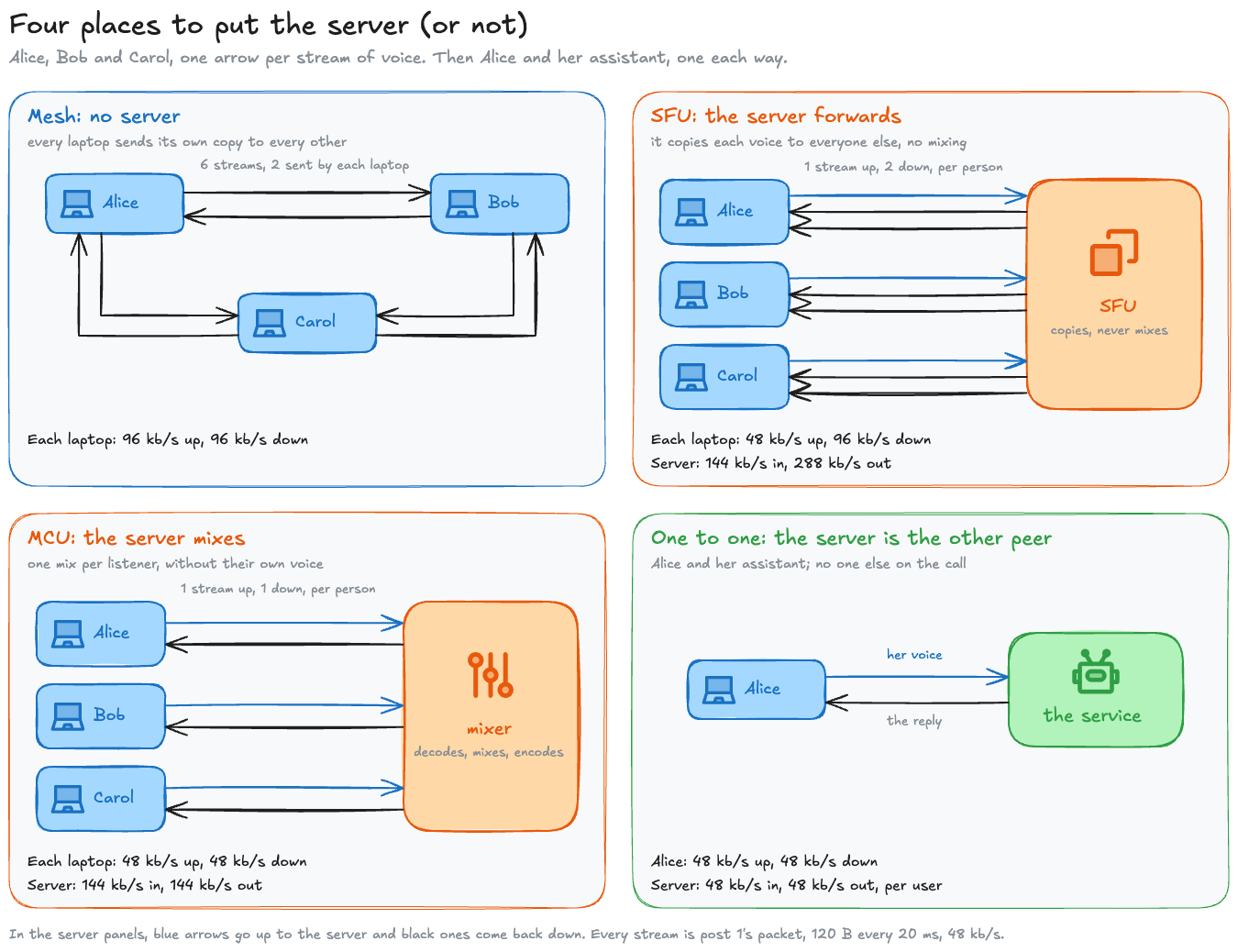
I wrote a small script, topology_cost.py, that does this counting for any size of call, and every traffic number from here on comes from it. The counting itself is a handful of lines, one function per shape:
def mesh(n: int) -> Cost: peers = n - 1 return Cost("mesh", peers, peers, None, None, ...)
def sfu(n: int, loudest: int | None = None) -> Cost: k = n if loudest is None else min(loudest, n) heard = min(k, n - 1) # a listener who is not among the k hears all k; a selected speaker hears k - 1 out = k * (n - 1) # each forwarded stream goes to everyone but its sender name = "SFU" if loudest is None or k == n else f"SFU, {k} loudest" return Cost(name, 1, heard, n, out, ...)
def mcu(n: int) -> Cost: return Cost("MCU", 1, 1, n, n, ...)Trimmed to the stream counts; the ... is the per-box work, which comes later.
The four numbers in each Cost are streams: what one laptop sends, what it receives, what the server receives, what the server sends. n is the number of people. In a mesh each laptop sends and receives n - 1, one per other person, and there’s no server. The SFU receives n and sends out, each voice to everyone but its owner. k is how many voices it forwards: all of them for now (we’ll get to forwarding only the loudest), so each listener hears heard = n - 1. The MCU receives n and sends n, one mix each. Multiply by 48 kb/s and you have the traffic. For Alice’s call, n = 3:
one client the serverpattern up kb/s down kb/s in kb/s out kb/s out pkt/smesh 96 96 - - -SFU 48 96 144 288 300MCU 48 48 144 144 150The last column counts packets rather than bits, because a server spends its effort per packet: every one has to be received, unlocked or locked, and sent. To keep the counting simple, the script assumes everyone sends all the time, and leaves out the small reports from post 5.
With three people the shapes barely differ. They start to differ when the call grows, so let’s take them one at a time and see what happens to Alice’s sentence in each.
Mesh: Alice posts every copy herself
In a mesh, Alice’s browser opens a separate connection to Bob and another to Carol, each with its own path, its own handshake and its own keys. Every 20 ms she locks that slice of “ship on Friday” twice, once for each of them, and sends it twice. That’s her 96 kb/s up.
Now imagine the call grows to ten people. Her sentence goes out nine times: 432 kb/s, nine times a two-person call, and the same from every laptop on the call, over whatever connection each person happens to have (RFC 8834 §12.1.2 describes the same cost).
Does Alice encode her voice once, or once per listener?
Possibly once per listener. Each connection backs off on its own, the way post 5 described, so Bob’s might be running at 32 kb/s on the wire while Carol’s is still at 48, and one encoder can’t produce both. RFC 7667 draws the WebRTC kind of mesh with the microphone “fed into two different encoder instances” for that reason (§3.4). Whether a particular browser shares one encoder between connections I haven’t checked, so take the encodes as “up to one per listener”. The locking isn’t in doubt: one connection per listener means one key per listener.
Your own browser can show you this. Start the call, then add listeners one at a time, and watch Alice’s upload:
This lab runs a real call in your browser, so it needs JavaScript.
What mesh buys is privacy. There’s no machine in the middle, so nobody but the people on the call ever holds a key.
The cost is that every copy is made and sent by the laptops, and every person who joins adds one more to each of them. What if a server made the copies instead?
SFU: the post office
With an SFU, Alice sends her sentence once, to the server, and the server sends a copy to Bob and another to Carol. Her upload stays at 48 kb/s however big the call gets.
The listeners don’t get off as lightly. Bob still receives a separate stream for each other person, and plays them together on his own laptop. And the server’s way out is where the growth goes: each person’s voice leaves it once per listener. With three people that’s 3 × 2 = 6 streams, 288 kb/s. With ten:
one client the serverpattern up kb/s down kb/s in kb/s out kb/s out pkt/smesh 432 432 - - -SFU 48 432 480 4320 4500MCU 48 48 480 480 500Ten voices, nine copies each: 90 streams, 4,500 packets every second out of one server, for one call. Twenty people would be 380. That’s growth with the square of the call: the number of people times the number of listeners each one has.
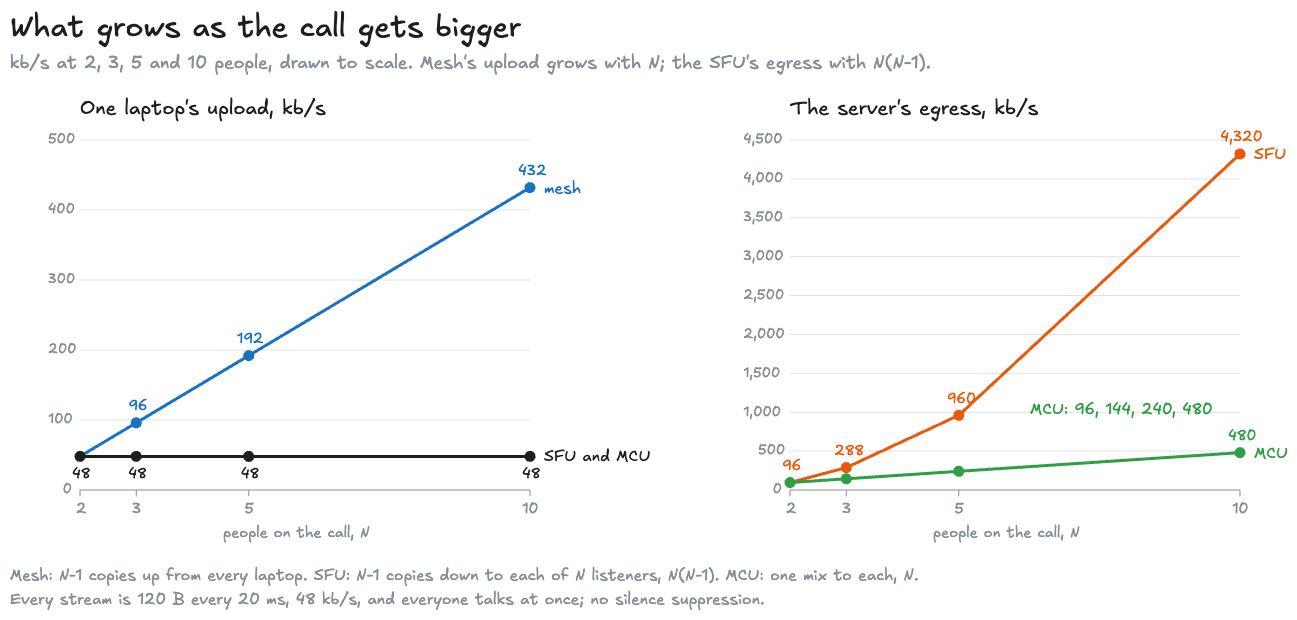
A mesh sends the same 90 copies; it just spreads them across everyone’s laptops. An SFU sends all 90 itself.
Why the post office has to open the envelope
To forward Alice’s packet, the SFU needs to know whose voice it is, and that’s written on the outside: the RTP header, which post 4 showed is never encrypted. So you might expect it to read the label and pass the sealed envelope along untouched.
It can’t, because Alice sealed it for the SFU, not for Bob. She did her handshake with the server, and so did Bob, separately. Alice and Bob never did one with each other, so Bob holds no key that opens her packet. The SFU has to unlock each packet with Alice’s key and lock a fresh copy with Bob’s, and another with Carol’s. What it never has to do is decode the sound, turn the bytes back into audio. RFC 7667, which calls an SFU a “selective forwarding middlebox” (SFM), puts the rule plainly: “If encryption is employed, the Media Translator, SFM, and mixer need to be able to decrypt the media to perform its function” (§6).
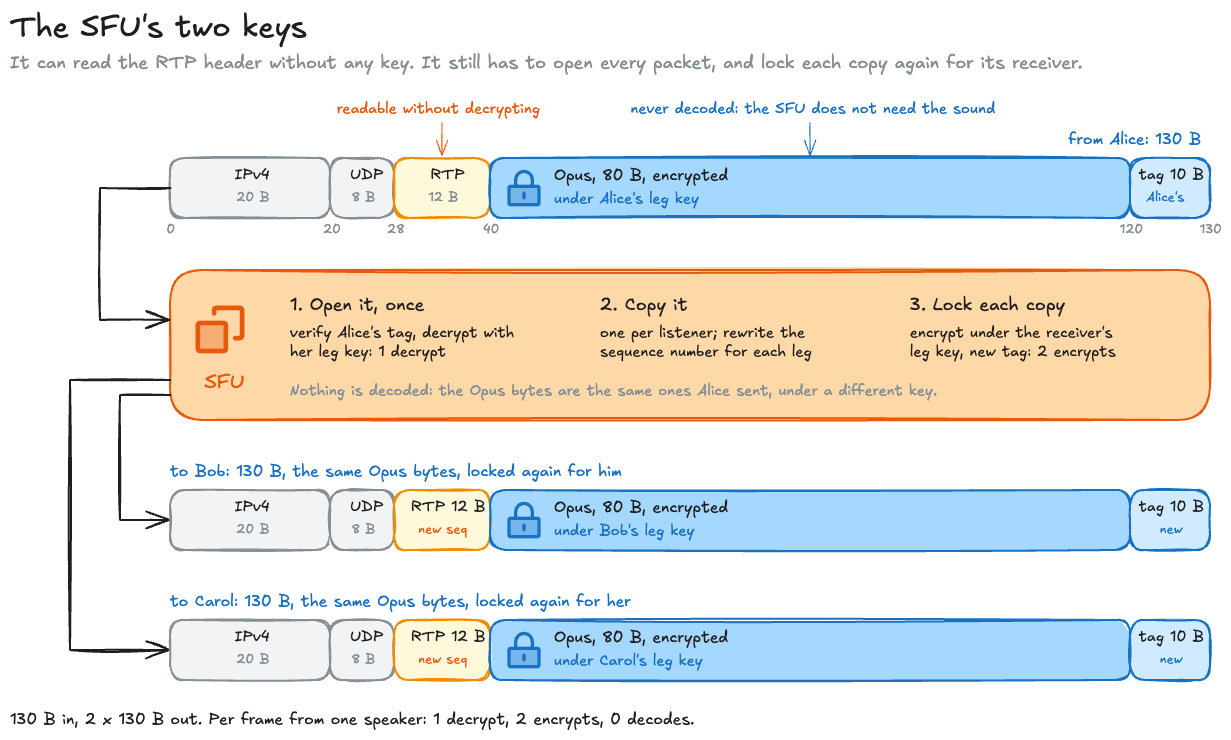
Now be the SFU yourself. Press Forward it untouched to Bob first, then Unlock with Alice’s key, relock for Bob and Carol. The keys are made in your browser when the page loads, so the first one really does fail:
This lab runs a real call in your browser, so it needs JavaScript.
The second script, measure.py, runs a real SFU on one laptop, with real SRTP (post 4’s locking) on real packets, so we can time it. Its whole job, every 20 ms, is this loop:
for i in range(n): plain = s_in[i].unprotect(wire[i][f]) for j in range(n): if j != i: s_out[j].protect(plain)SRTP’s words for unlocking and locking are unprotect and protect. For each person i, the SFU unlocks their packet once, with the key it shares with them. Then, for every other person j, it locks a copy with the key it shares with j. There’s no decoder in the loop and no encoder. For Alice’s call that’s 3 unlocks and 6 locks every 20 ms, and nothing else.
Forwarding only the people talking
On a big call, most people are listening most of the time, so forwarding all ten voices to everyone is mostly forwarding silence. An SFU could forward only the loudest few, but to know who’s loud it would seem to have to decode everyone, which is exactly the work it exists to avoid.
The fix is to have each sender write down its own loudness. You saw it in Alice’s offer in post 4, as ssrc-audio-level: each packet carries one extra byte saying how loud that 20 ms was, from 0 for the loudest to 127 for silence (RFC 6464). The SFU compares those numbers across senders and forwards the top few, without listening to anything. The open-source SFU mediasoup describes its version in seven words: “No decoding of audio data is done” (docs).
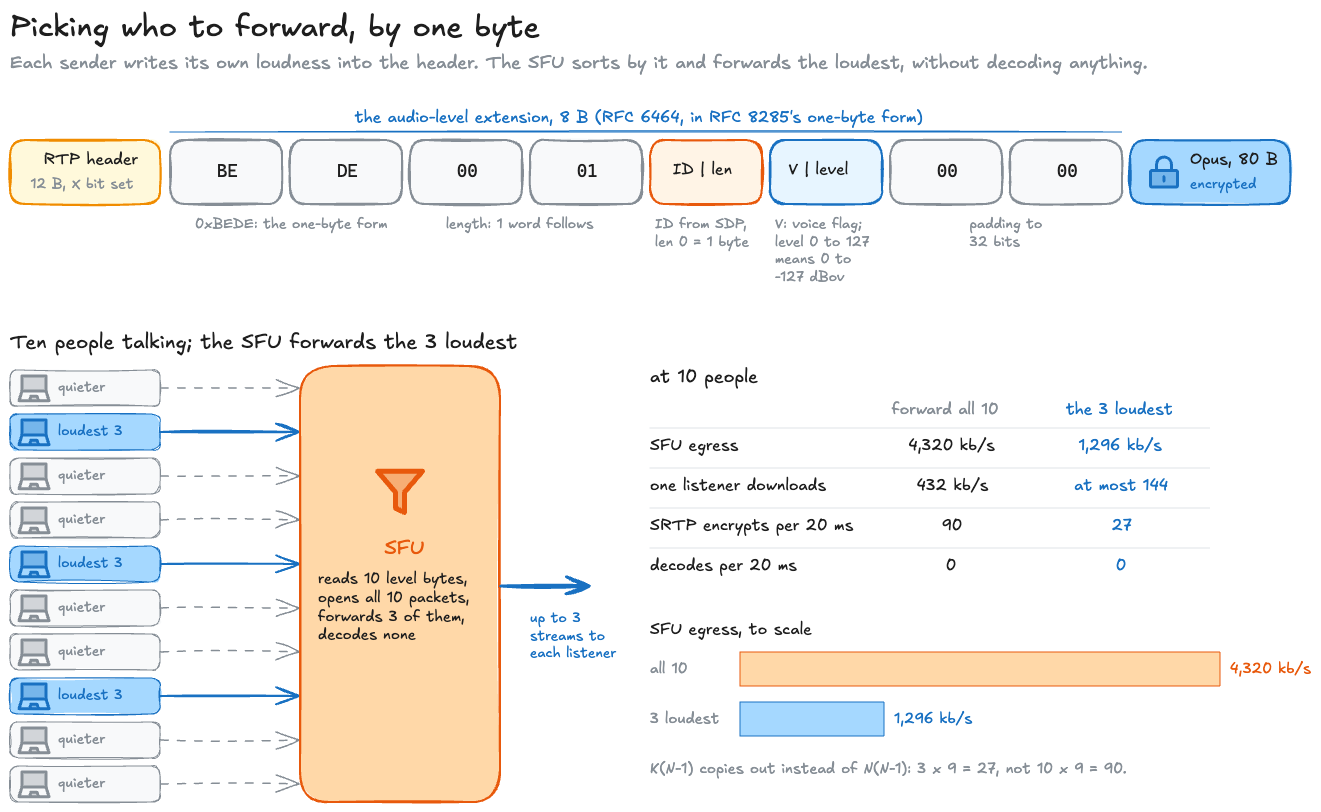
| Ten people | Forward everyone | Forward the 3 loudest |
|---|---|---|
| The SFU sends | 4,320 kb/s | 1,296 kb/s |
| One listener receives | 432 kb/s | 144 kb/s, or 96 for one of the three speakers |
| Locks every 20 ms | 90 | 27 |
| Sounds decoded by the server | 0 | 0 |
From topology_cost.py -n 10 --loudest 3, still counting post 1’s 120-byte packet.
The byte isn’t free: in its common short form, the extension adds 8 bytes to every packet, so Alice’s packet with it and post 4’s tag is 138 bytes rather than 130.
Why skipping packets means renumbering them
Each stream Bob receives is numbered packet by packet, and post 5’s loss count reads a gap in the numbers as a lost packet. If the SFU stops forwarding Carol while she’s quiet, Bob’s laptop would count her silence as loss. So an SFU that skips packets renumbers each stream it sends, which is the rewritten number in the figure above. Post 4 showed that the header is readable but covered by the tag, so it can’t be changed without the key. That’s no obstacle here: the SFU is writing a new tag for every copy anyway, with the listener’s key, and the new number goes under it.
Can the loudness byte be hidden?
It rides in the clear, like the rest of the header, and a loudness trace can give away when someone is speaking. RFC 8834 recommends encrypting it, and RFC 9335’s “cryptex” does that, though post 4 found libwebrtc ships it switched off. Either way it isn’t hidden from the SFU, which holds the keys.
Video does the same, with sizes instead of speakers
For video, an SFU picks which version of each stream to send each receiver: senders upload a few sizes at once (simulcast, RFC 8853) or one stream built in layers, and the SFU forwards the size that fits each receiver’s connection. Still no decoding: it’s choosing packets by their headers, as with audio.
Even with the SFU doing all the copying, Bob’s laptop still receives a separate stream for each speaker, decodes each one and plays them together. What if the server did that too?
MCU: the editor
An MCU is the editor from the mail analogy. It decodes everyone’s stream back into sound, adds the sound together, and sends each person a single stream.
But not the same stream to everyone. Bob’s mix has to leave Bob out: his own voice coming back from the server, a moment after he said it, would sound like an echo. RFC 7667 says exactly that: “each endpoint gets a mix of all other sources except its own, as this would result in an echo” (§3.6.1). A mix of everyone but the listener is called mix-minus. So Alice’s “ship on Friday” goes into Bob’s mix and Carol’s, but not into her own.
Hear it for yourself. Choose to be Bob and play your mix, then tick Leave my own voice in the mix and play it again:
This lab runs a real call in your browser, so it needs JavaScript.
So with three people the MCU makes three different mixes, and encodes and locks each one for its listener.
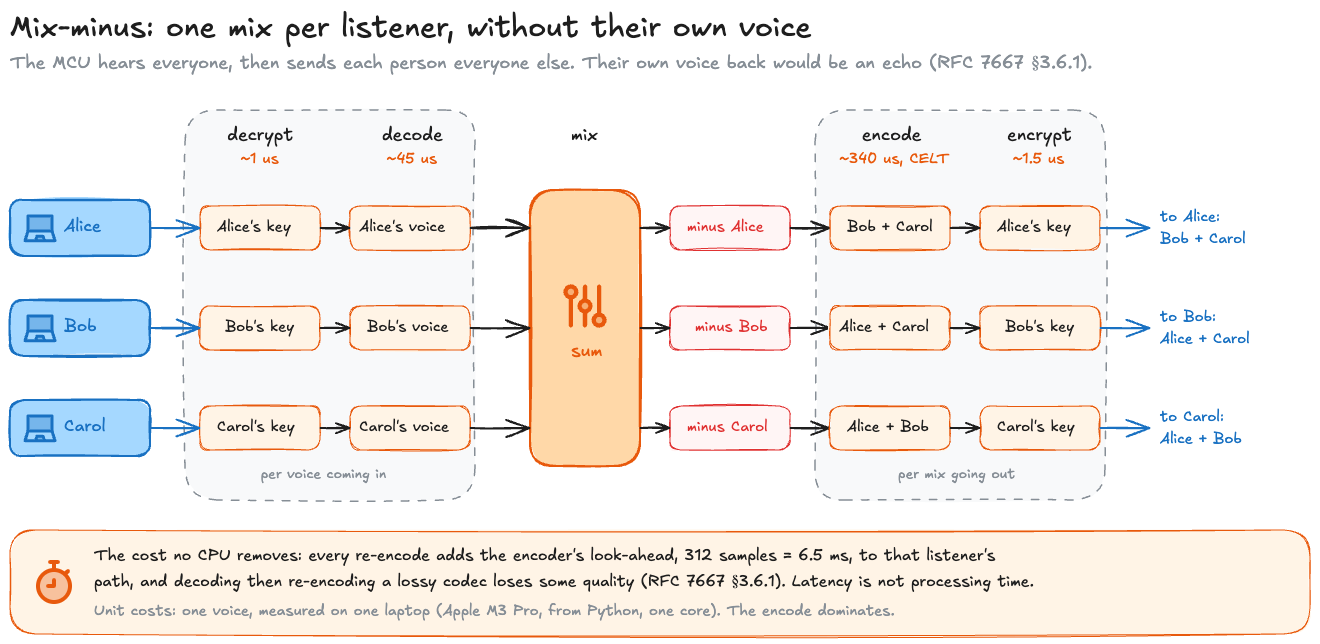
For the laptops this is the cheapest shape there is: one stream up, one down, one decode, whatever the size of the call. That’s the reason mixers exist at all: RFC 7667 notes they “were introduced in pre-RTP times” so that devices able to take only a single stream could join a conference (§3.6.1). The server’s traffic is modest too: one stream in and one out per person, 144 kb/s each way for Alice’s call.
The price is paid in the server’s processor. Here’s measure.py’s MCU, one 20 ms frame:
for i in range(n): payload = m_in[i].unprotect(wire[i][f])[12:] pcm.append(np.concatenate([fr.to_ndarray().reshape(-1) for fr in decs[i].decode(av.Packet(payload))]))stacked = np.stack(pcm).astype(np.int32)total = stacked.sum(axis=0)for i in range(n): mix = np.clip(total - stacked[i], -32768, 32767).astype(np.int16) packets = encode_frame(encs[i], mix, f * SAMPLES) for p in packets: m_out[i].protect(rtp(f, f * SAMPLES, 0x4D430000 + i, p))The timing lines are left out.
Read it in three steps:
- Unlock and decode everyone. For each person, unlock the packet, drop its 12-byte header, and decode the 80 bytes of Opus back into sound: 960 numbers, one for each 1/48,000 of a second.
- Add everyone once.
totalis the whole room, every voice added together, number by number. - Take each listener back out.
total - stacked[i]is the mix-minus: the room minus personi. The sum is done in 32-bit numbers so it can’t overflow, andnp.clipthen squeezes it back into what a 16-bit sample can hold, because three loud voices added together can exceed it. Then the mix is encoded into Opus again (encode_framereturns a list, usually of one packet), wrapped in a fresh RTP header byrtp(...), with the MCU’s own stream ID because each mix is a new stream, and locked for personialone.
The long second line looks worse than it is: it decodes the packet and flattens the result into one row of 960 numbers.
Where the SFU’s loop had no decoder and no encoder, this one has one of each per person, every 20 ms. The script times both on the same laptop, a thousand frames each, and the gap is about a hundred times at every size. For Alice’s call, the SFU took 7 µs a frame and the MCU about 1.2 ms. At ten people, mixing one 20 ms frame took half of those 20 ms, so one processor core could keep up with about two such calls; forwarding the same call took 77 µs, room for about 260.
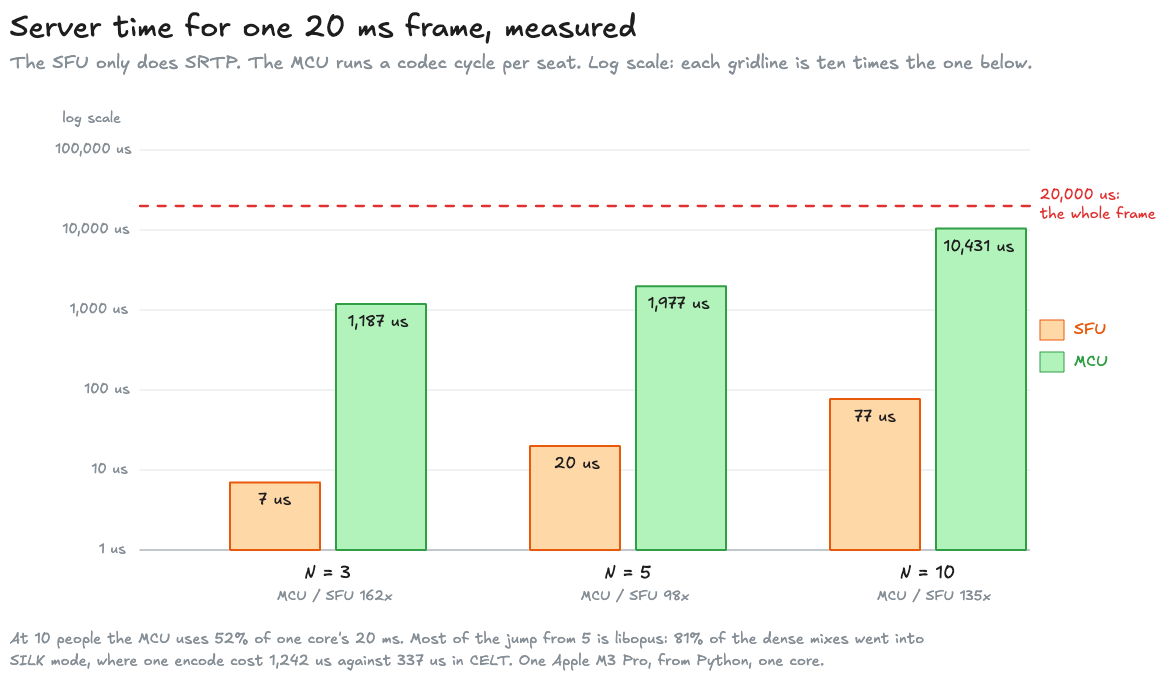
| People | MCU, time per 20 ms frame | SFU | MCU / SFU |
|---|---|---|---|
| 3 | 1,187 µs | 7 µs | 162x |
| 5 | 1,977 µs | 20 µs | 98x |
| 10 | 10,431 µs | 77 µs | 135x |
Median of 1,000 frames on one Apple M3 Pro, one core, from Python. A server written in C or Go would be faster at both, so don’t plan capacity from these numbers.
The gap is the claim, and my guess is that it’s an underestimate: the MCU’s time is mostly libopus, which is already C, while the SFU’s tiny times are mostly Python calling into libsrtp, which a C server wouldn’t pay.
The measurement in detail, and why ten people cost five times as much as five
The voices are post 2’s synthetic vowel, one per person at a different pitch. The libraries are PyAV 19.0.0 (libopus 1.6.1) for Opus and pylibsrtp 1.0.0 for SRTP, with every codec and key kept alive for the whole call, as a server would. The ratios in the table come from the unrounded medians, which is why 1,187 / 7 doesn’t give exactly 162. They jump around, 162x then 98x then 135x, because the SFU’s times are so small, 7 to 77 µs, that a microsecond either way moves the ratio a lot.
Ten people cost more than twice five because Opus picks one of three modes frame by frame, depending on the sound: SILK, built for speech, CELT, built for music and dense sound, and a hybrid of the two. Encoding a frame in SILK cost 1,242 µs here against 337 µs in CELT, and libopus put 81% of the ten-person mixes into SILK alone. So an MCU’s cost depends on what it’s mixing, not only on how many people there are. Real speech may land differently.
Two costs don’t go away with a faster processor. Opus holds back a little sound each time it encodes so it can look ahead, 6.5 ms in this build, so the MCU’s second encode adds that much delay to everyone’s audio. And Opus throws away detail to compress, so decoding and compressing again loses a little more, like a photocopy of a photocopy. (I haven’t measured that loss here.)
A real implementation of each, to read
The open-source Janus server ships both shapes: its VideoRoom plugin is an SFU, and AudioBridge is “an audio conference bridge … specifically mixing Opus streams” (docs).
Now that all three are on the table, grow the call. Pick a shape, drag the number of people up, and watch where the lines pile up. Then set the SFU to forward only the 3 loudest:
This lab runs a real call in your browser, so it needs JavaScript.
Who can hear the call
Back to the mail for a moment. The post office never reads Alice’s letter, but it does open the envelope, and whoever opens the envelope could read it. The same goes for every machine we’ve met that unlocks the audio: each laptop in a mesh, the SFU, the MCU. Each one did the connectivity checks from post 3 and a handshake from post 4, holds keys, and unlocks the sound. Being that machine is called terminating the call. A server in the middle still counts: each leg has two ends, and the SFU or MCU is one end of every leg it serves.
Here’s a packet you’ve seen before, Alice’s to her assistant in post 4, locked. Any leg looks the same, so here’s what three different kinds of machine on its path can read:
45 b8 00 82 … c0 00 02 0a c6 33 64 14A router reads this, to pick the next hop: from 192.0.2.10 to 198.51.100.20, the assistant's server, 130 bytes long. It holds no keys.d4 31 c3 54 00 6e …A keyless relay reads this far, the addresses and ports, to pick where to send it on. You've met one: post 3's TURN relay carries every packet of a call, locked as they are.80 6f 03 f2 00 00 25 80 1f 2e 3d 4cAnyone can read this, never encrypted: packet 1010 of Alice's stream 0x1F2E3D4C. The label on the envelope.62 23 76 62 5a f9 71 28 … 72 moreOnly an endpoint reads this: the machine holding this leg's key. It's the one that terminates the call.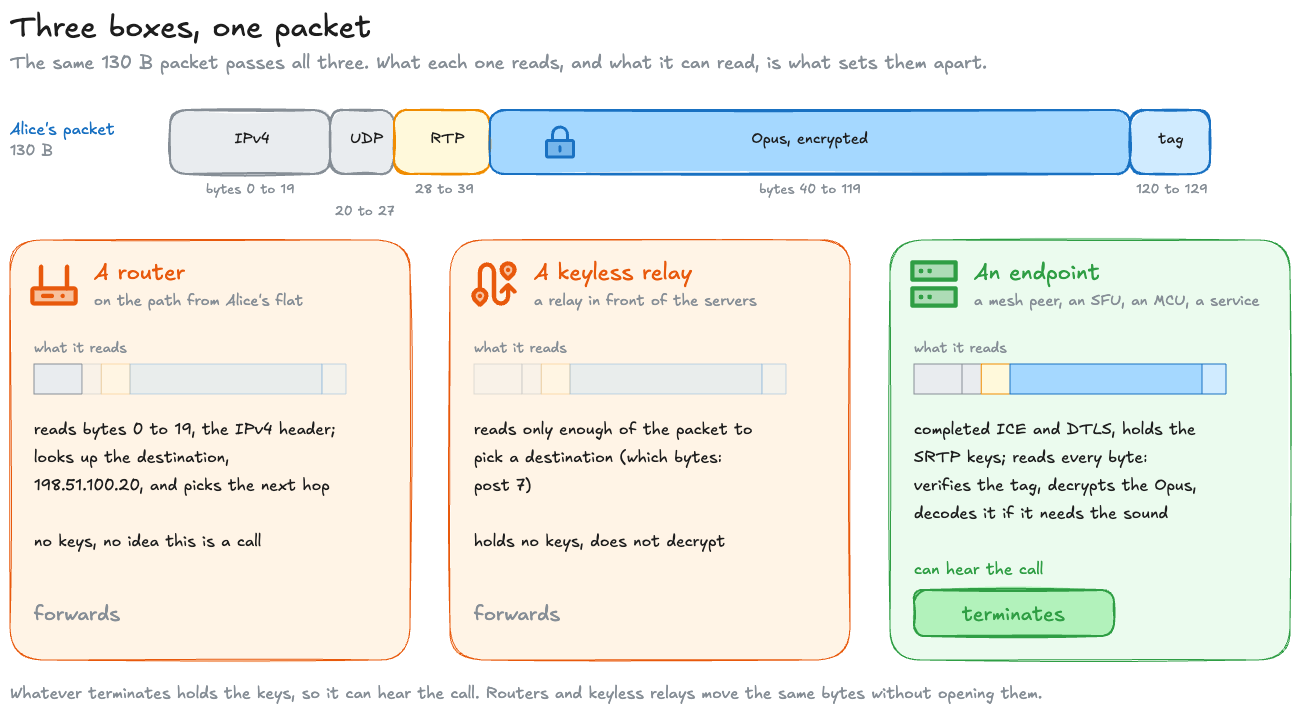
So the rule is simple: whatever terminates the call can hear it. In a mesh that’s only the people on it. With an SFU or an MCU, it’s the server too, and RFC 7667 warns that one that’s “subverted or misbehaving” has “full access” (§6).
An SFU that can't listen
There’s a way to keep an SFU out of the audio: put a second lock on the sound, inside the first, with a key only the people on the call share. The SFU still unlocks the outer layer, reads the header and forwards, but the sound inside stays locked to it. That’s what SFrame (RFC 9605) and the double encryption of PERC, Privacy-Enhanced RTP Conferencing (RFC 8723) do. An MCU can’t work that way at all, because it has to hear the sound to mix it.
Back to the assistant: the server is the other end
Back to 9:17 AM, Alice and her assistant. In the mail analogy this is a letter to one pen pal: one envelope, no copies, no post office, no editor. The assistant’s server isn’t forwarding Alice to anyone or mixing her with anyone; it’s simply the other end of the call. RFC 7667’s catalogue of shapes starts with exactly this one, point to point: “A sends to B, and only B, while B sends to A, and only A” (§3.1). The server is B.
The work per conversation is one stream each way, 48 kb/s. Every 20 ms there’s one unlock and one decode of what Alice says, since the AI model needs her voice as sound, and one encode and one lock of the reply. That’s one seat at an MCU, without the mixing. measure.py times it too: 384 µs a frame on the same laptop, about fifty conversations per core at that speed.
Large voice services have written about this choice. OpenAI’s article on their voice infrastructure (OpenAI) says they considered the usual group-call design, an SFU, with the AI joining the call as one more participant. But “[m]ost sessions are 1:1”, one person talking to one model, so there’s nothing to forward.
What they built instead is a service at the edge, meaning the first of their servers a user’s packets reach, which terminates the call. They call it a transceiver. Behind it, the audio travels to the other services in “simpler internal protocols”, so that those services can “scale like ordinary services instead of acting as WebRTC peers themselves”.
Why does that matter? Because being a WebRTC peer means doing everything we’ve covered so far:
| A WebRTC peer has to | From |
|---|---|
| Keep a jitter buffer and cover for lost packets | Post 2 |
| Answer connectivity checks and keep the path alive | Post 3 |
| Do a handshake and hold keys for every call | Post 4 |
| Send and read reports, and back off when the path gets worse | Post 5 |
And all of that belongs to one machine for the whole call. The path from post 3 ends at that machine’s address, and the keys from post 4 live in its memory. If it’s busy, the call can’t simply move to another one. An ordinary service, the kind that’s easy to scale, works the other way: any of many identical machines can take the next piece of work, so you add machines when it’s busy and take them away when it isn’t. With a terminating edge, only the edge has to be a WebRTC peer, and the AI model behind it just receives audio, like an ordinary service.
Choosing one
Here’s Alice’s one 20 ms slice once more, through every shape at once:
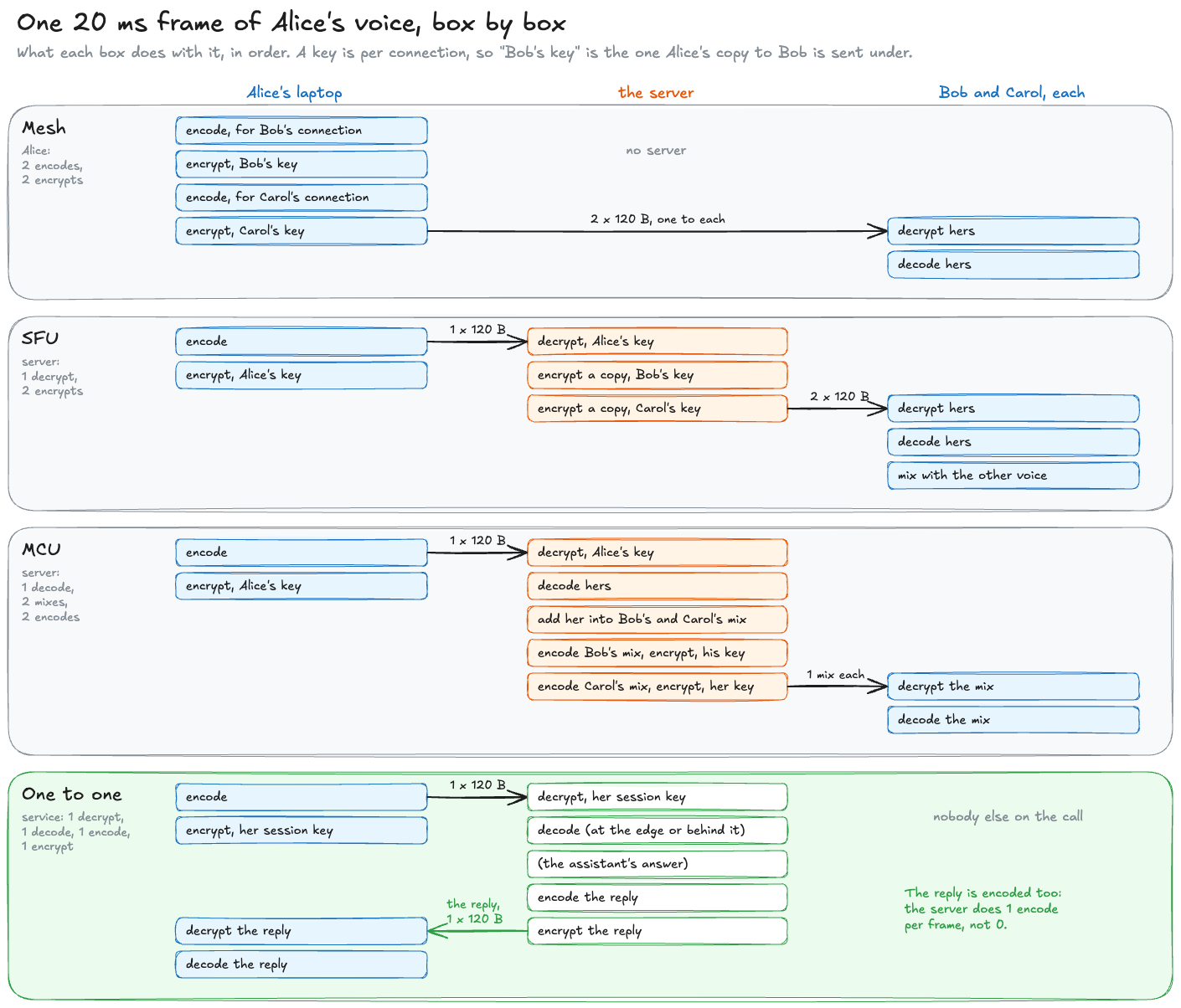
| Shape | What grows with the call | Who pays | Who can hear the call | What you get |
|---|---|---|---|---|
| Mesh | Each laptop’s upload and download, one stream per other person, and its decodes | Every laptop’s connection and processor | Only the people on it | No server at all |
| SFU | The server’s traffic, people × listeners, and each listener’s download | Server bandwidth, and a lock per copy | The SFU | Every speaker as a separate stream, no sound processing on the server, speaker selection to tame the growth |
| MCU | The server’s work, a decode and an encode per person | The server’s processor, plus a little delay and quality | The MCU | One stream per laptop, for devices that can’t take more |
| The server is the other end | Nothing: one stream each way, per conversation | The service’s codec work per user | The service | A backend that doesn’t have to be a WebRTC peer |
Read off the table: two or three people who care about privacy, mesh. A group call, an SFU, forwarding only the loudest few once it’s more than a handful. Devices that can only take one stream, or a bridge to the phone network, where each call is a single channel of sound, a mixer. One person and a service, terminate at the edge and let everything behind it be an ordinary service.
To compare exact numbers for a call of any size, all four shapes side by side. Its Packet choice adds what a real call carries on top of post 1’s 120 bytes: the SRTP tag, IPv6’s longer header, and header extensions such as the audio level:
The demo
Both scripts are in where-the-server-sits/: topology_cost.py does the counting for any size of call, and measure.py runs a real MCU, a real SFU and the one-to-one case with real Opus and real SRTP, and times a frame of each.
cd mainlog-code/where-the-server-sitspython3 topology_cost.py # no install needed: 2, 3, 5 and 10 peoplepython3 topology_cost.py -n 10 --loudest 3 # an SFU forwarding the three loudestpython3 -m venv .venv && .venv/bin/pip install -r requirements.txt.venv/bin/python measure.py # the timings, on your machineIts CI checks the counting against a slow count that lists every copy of every voice, for every call size from 2 to 30, and checks that the MCU stays more than twenty times the SFU’s cost on whatever machine runs it.
So Alice’s “ship on Friday” can be copied by her own laptop, by a server that unlocks and relocks it, or by one that mixes it into everyone else’s sound, and in each case the cost lands somewhere different. Her assistant needs none of that, but its server terminates the call and has to own it, path, keys and all, for as long as the call lasts. That makes it hard to put behind an ordinary load balancer, which spreads packets across machines without knowing which call each belongs to. Next, how a packet finds the one server that owns its call, without the box in front holding any keys.
Related posts
SFU, MCU, and the participant that has to decode
Put an AI agent in a group call and two questions decide the design: does the model hear each person, or one blend, and who has to hold the keys? Both come down to where the agent's audio gets decoded.
AI & agentic architecturesai-agentswebrtcarchitecture
Half the bitrate, two thirds the traffic
Halving an audio bitrate from 32 to 16 kb/s took traffic from 48 to 32, because every packet's headers stay the same size. Packet rate is the other control.
Down to the wireaudionetworkingperformance
Inside toolbench: the runtime for small interactive web tools
The internals of toolbench, the framework behind mainLog's tools: what the runner guards against, why a worker exists only to be terminated, how a graph is laid out and routed the same in every browser, how known answers and size budgets keep tools honest, and why every migration is the identity function.
frameworksarchitecturetesting
 AI
SFU, MCU, and the participant that has to decode
Put an AI agent in a group call and two questions decide the design: does the model hear each person, or one blend, and who has to hold the keys? Both come down to where the agent's audio gets decoded.
ai-agentswebrtcOct 2026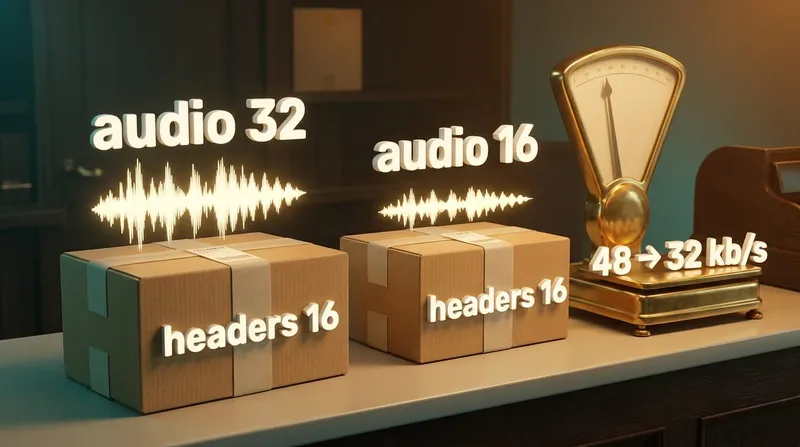 Networking & media
Half the bitrate, two thirds the traffic
Halving an audio bitrate from 32 to 16 kb/s took traffic from 48 to 32, because every packet's headers stay the same size. Packet rate is the other control.
audionetworkingAug 2026 Software craft
Inside toolbench: the runtime for small interactive web tools
The internals of toolbench, the framework behind mainLog's tools: what the runner guards against, why a worker exists only to be terminated, how a graph is laid out and routed the same in every browser, how known answers and size budgets keep tools honest, and why every migration is the identity function.
frameworksarchitectureOct 2026
Comments