State machine analyzer
/tools/state-machine-analyzer/A completeness check for a state machine. Write each state and what its events do, and see which pairs nobody decided, which states can't be reached or left, and where two rules disagree.
A completeness check for a state machine. Write each state and what its events do, and see which pairs nobody decided, which states can't be reached or left, and where two rules disagree.
Is this state machine finished? A machine is usually drawn as its happy path, a dozen arrows. Written as a table, every state against every event the code can observe, most cells are an event arriving where nobody expected it: a late reply, the user changing their mind, a webhook delivered twice, the model going down. Each of those cells needs a decision, and each decision is a test.
You write the states and what each event does in them. The tool shows:
| Output | What it tells you |
|---|---|
| Coverage | One line: how many state and event pairs are decided, how many are not, and a conflict or a state that can’t be reached or left, when there is one |
| The grid | Every event against every state, each cell in words or a symbol: → search, stay, a faint ✕ for reject. A red ? is undecided. The events open in the most states come first |
| The graph | The states and the moves between them, laid out along the happy path, with each arrow labelled by its events. A state that can’t be reached or left is amber |
| Gaps | States that can’t be reached, states that can’t be left, and cells two rules disagree about, by line |
| Text to copy | Under Also write: the grid as a markdown table with the gaps as a list, for your docs, a pytest skeleton, one test per cell, failing where no rule decides, or both |
It’s for anything that reacts to events: an agent workflow, a webhook handler, a protocol, an order’s lifecycle.
Say you’re building a dinner-booking agent. It gathers the day, time and party size, searches for a table, asks the
user to confirm, books it, pays the deposit, and texts the group. You’ve drawn the happy path, and you have a degraded state for
when the model is down, but no arrows to it yet.
1. Write what you drew. Each state is a line ending in a colon. Its rules go beneath it.
gather:  slots_complete -> search  slots_missing  -> staysearch:  slot_free -> confirm  none_free -> gatherconfirm:  user_yes -> book  user_no  -> gatherbook:  committed -> stay  unknown   -> stay  refused   -> gather  paid      -> notifynotify:  sent        -> done  send_failed -> reportreport:  told -> donedegraded:
events: user_revises, slot_gone, model_unavailable, model_back
The last line lists four events your code can observe that no rule mentions yet: the user changing the request, the restaurant giving the table away, and the model going down and coming back.
2. Press Run, and read the top of the result. One coverage line:
Decided 13 of 119 pairs 7 states x 17 events: 10 moves and 3 stays. It starts at gather and ends at done.Undecided 106 Marked ? in the table, most open events first.Shape degraded can't be reached or leftIn plain words: there are 119 moments your agent can be in, and you’ve decided what happens in 13 of them. If the
user says “make it 8 instead” at any point, nothing says what the agent does. done has no rules of its own, so it’s
where the machine ends rather than a row.
3. Read the grid. Events run down the side, states across, the events open in the most states first. The first rows look like this:
Event gather search confirm book notify report degradeduser_revises ? ? ? ? ? ? ?slot_gone ? ? ? ? ? ? ?model_unavailable ? ? ? ? ? ? ?model_back ? ? ? ? ? ? ?slots_complete → search ? ? ? ? ? ?slots_missing stay ? ? ? ? ? ?→ search is a move to search, stay keeps the machine where it is, and ?, in red, is a cell no rule decides. The
four events no rule mentions come first, ? from end to end, and the degraded column is ? all the way down. Ties
keep the order you wrote them in, so a finished machine reads in its written order.
4. Look at the graph. The happy path runs left to right and is highlighted: gather, search, confirm, book,
notify, done. report hangs off notify, and degraded sits on its own, amber, with the note can’t be reached or
left: no arrow goes in and none comes out. The stay rules aren’t drawn, because they don’t move the machine; the
grid shows them.
5. Read the gaps.
| Gap | Where | Why |
|---|---|---|
| Can’t be reached | degraded | Nothing leads here from gather, the start. |
| No way out | degraded | No event moves it to another state. |
You drew a box for the model being down, but no arrow goes in and none comes out.
6. Decide some cells, and Run again. Add:
gather, notify: model_unavailable -> degraded # these states need the modeldegraded: model_back -> backback returns to the state the machine came from. Now Decided is 16 (13 moves and 3 stays), Undecided 103, the gaps
table is gone, and user_revises and slot_gone lead the grid, still ? in every state. In the
graph, degraded loses its amber, and dashed arrows labelled model_back, back run from it to gather and notify, the
two states it can return to.
7. Beware the one-line fix. Adding this decides every cell:
every state: anything else -> rejectUndecided drops to 0 and Decided reads 13 moves, 3 stays and 103 rejects. That is honest only if you mean it: rejecting
user_revises in confirm means ignoring a user who changes the time while being asked to confirm it. The sample
Booking, all cells decided makes each of those decisions on purpose: 32 move, 22 stay, 6 defer and 59
reject.
8. Take it with you. Under Also write, tick Markdown and Run. Under the gaps comes the grid as a
markdown table, starting 119 cells: 13 decided, 106 undecided. and ending with the gaps as a list:
Gaps:
- Can't be reached: degraded. Nothing leads here from gather, the start.- No way out: degraded. No event moves it to another state.
Paste it into the design doc, and the open questions are in front of whoever reviews it. Ticking pytest gives the same cells as tests, after the table when both are ticked.
gather: a state; the first one written is the start slots_complete -> search a move: event -> next state slots_missing -> stay an outcome instead of a state user_yes, user_no -> confirm several events at once slot_gone -> stay # why text after # is the reason, kept in the gaps and the testsgather, search: a block for several statesevery state: every state written anywhereevery state except book, notify: every state but these anything else -> reject every event this state has no other rule forevents: model_back an event no rule uses yet# a comment a line starting with # is ignoredstay (the event is expected and changes nothing), defer (hold it until the state’s work
finishes), reject (it shouldn’t arrive here: log it and do nothing), ignore (it’s irrelevant here), and
back (return to the state the machine came from). The tool doesn’t interpret the first four beyond counting and
shading them.done, is where the machine ends. If a
typo creates one, it shows up in the coverage line: ends at done and serach.events: line, in the order first written._, . and -, with no spaces, so payment.succeeded is
fine.->, => or →. * means the same as anything else.every state. A block that names its states beats an every state block of the same size. Any named event beats
anything else. So you can write the general case once and the exceptions beneath their states, in any order.stay.back adds nothing, because it only returns
somewhere already reached.back.back is a dashed arrow to each state that moves into the one it’s in, because those are where it
can return. stay, defer, reject and ignore leave the machine where it is, so they’re left out rather than
drawn as loops: a finished machine has one on almost every state, 22 in the booking, and they’d bury the moves. The
highlighted happy path starts at the first state and takes each state’s first-written move to somewhere new, so
an exception written later, like committed -> report, doesn’t become the main line.→ state for a move, ↩ back, stay, defer, ignore, ✕ for reject, ? for undecided,
and 2 rules for a conflict. ? and 2 rules are red and defer amber, because they’re the cells that need
someone; a move is green. A reject is a faint ✕ for the same reason: in a finished machine most cells are
rejects, and writing each one out, or colouring it like a gap, would bury the moves and the gaps.✕ reject, because a pasted table travels without the grid around it. Paste it
into a design doc or a pull request, and the table survives review.None where
no rule decides, so that test fails until one does. You write deliver, which puts your machine in a state and
delivers an event.back, which Harel’s statecharts call a history
state.mainlog-code/agent-state-machines/booking.py, cell for cell.index.ts/** * State machine analyzer: a completeness check for a state machine. Every state against every event, which cells nobody * decided, which states can't be reached or left, and where two rules disagree. * * A state machine is usually drawn as its happy path. Written as a table, most of its cells are an event arriving in * a state that wasn't waiting for it, and each needs a decision. The input is written the way a person sketches one: * * gather: a state; the first one is the start * slots_complete -> search a move * slots_missing -> stay an outcome: stay, defer, reject, ignore, or back * search: * slot_free -> confirm # a reason shown in the gaps and the tests * every state except search: a block for several states; also "a, b:" and "every state:" * model_unavailable -> degraded * anything else -> reject every event this state has no other rule for * events: model_back an event no rule uses yet * * A target with no header of its own, `done` say, is where the machine ends: it is not a row, because nothing * happens after it. The narrower rule wins: a state's own header beats a block of three, which beats `every state` * (and a block that names its states beats an `every state` block as large), and any named event beats * `anything else`. Two rules equally narrow that say different things about one cell are a * conflict, and the cell is left undecided until someone picks. */import type { Cell, Field, GraphEdge, GraphNode, Output, Tool } from "@toolbench/sdk";
type Input = { machine: string; also: string[] };
class InputError extends Error { readonly at?: number; readonly len?: number; constructor(message: string, at?: number, len?: number) { super(message); if (at !== undefined) this.at = at; if (len !== undefined) this.len = len; }}
export type Kind = "move" | "back" | "stay" | "defer" | "reject" | "ignore";export type Outcome = { kind: Kind; to: string; line: number; reason: string };
const OUTCOMES = new Set(["stay", "defer", "reject", "ignore", "back"]);const RESERVED = new Set([...OUTCOMES, "every", "events", "anything"]);const NAME = /^\w[\w.-]*$/;
/** * How a cell reads in the grid. Words and a symbol, so a cell never has to be decoded from a colour. Only the cells * that need someone's attention carry a warning tone: an undecided or disputed cell is bad, and defer, which holds an * event for later, is warn. Reject is a bare ✕ in the muted tone, on purpose: in a finished machine most cells are * rejects, and writing or painting each one as loudly as a gap would hide the moves and the gaps. The legend says * what ✕ means. */export function mark(o: Outcome | null, rules = 0): { text: string; tone?: "good" | "warn" | "bad" | "muted" } { if (rules > 1) return { text: `${rules} rules`, tone: "bad" }; if (!o) return { text: "?", tone: "bad" }; if (o.kind === "move") return { text: `→ ${o.to}`, tone: "good" }; if (o.kind === "back") return { text: "↩ back", tone: "good" }; if (o.kind === "reject") return { text: "✕", tone: "muted" }; if (o.kind === "defer") return { text: "defer", tone: "warn" }; return { text: o.kind };}export const LEGEND = "→ moves to that state, ↩ back returns to the state before, ✕ reject drops the event, ? undecided, 2 rules is a conflict.";
type Where = { line: number; at: number; len: number };type Block = (Where & { names: string[] }) | (Where & { except: string[] });type Rule = { block: Block; events: string[] | "else"; outcome: Outcome };
export type Machine = { states: string[]; events: string[]; ends: string[]; start: string; /** One entry per state and event; null where nobody decided or two rules disagree. */ cells: Map<string, Outcome | null>; /** The cells two equally narrow rules disagree about, with every rule that claims them. */ conflicts: { state: string; event: string; rules: Outcome[] }[];};
export const key = (s: string, e: string) => `${s}\u0000${e}`;const split = (raw: string) => raw .split(",") .map((x) => x.trim()) .filter(Boolean);const quote = (s: string) => `"${s}"`;const and = (xs: string[]) => (xs.length < 2 ? (xs[0] ?? "") : `${xs.slice(0, -1).join(", ")} and ${xs.at(-1)}`);
/** Read the text and resolve every cell. Throws InputError on a line it can't read, naming the line. */export function parse(text: string): Machine { const states: string[] = []; const events: string[] = []; const blocks: Block[] = []; const rules: Rule[] = []; const addState = (s: string) => { if (!states.includes(s)) states.push(s); }; const addEvent = (e: string) => { if (!events.includes(e)) events.push(e); }; let block: Block | null = null; let offset = 0;
for (const [n, raw] of text.split("\n").entries()) { const at = offset; const len = raw.length; offset += raw.length + 1; const line = n + 1; const hash = raw.indexOf("#"); const body = (hash < 0 ? raw : raw.slice(0, hash)).trim(); const reason = hash < 0 ? "" : raw.slice(hash + 1).trim(); if (!body) continue; const fail = (msg: string): never => { throw new InputError(`Line ${line}: ${msg}`, at, len); }; const name = (x: string, what: string) => { if (!NAME.test(x)) fail(`${quote(x)} isn't a ${what} name. Use letters, digits, _ . and -, with no spaces.`); return x; };
const declared = /^events\s*:(.*)$/i.exec(body); if (declared) { for (const e of split(declared[1] ?? "")) addEvent(name(e, "event")); continue; }
const arrow = /->|→|=>/.exec(body); if (arrow) { if (!block) fail(`${quote(body)} has no state above it. Start with a state and a colon, like "search:".`); const lhs = body.slice(0, arrow.index).trim(); const rhs = body.slice(arrow.index + arrow[0].length).trim(); if (!lhs) fail("there is no event before the arrow."); if (!rhs) fail("there is nothing after the arrow. Write a state, or stay, defer, reject, ignore or back."); if (/\s/.test(rhs)) fail(`after the arrow comes one state, or stay, defer, reject, ignore or back, not ${quote(rhs)}.`); const word = rhs.toLowerCase(); const outcome: Outcome = OUTCOMES.has(word) ? { kind: word as Kind, to: "", line, reason } : { kind: "move", to: name(rhs, "state"), line, reason }; let evs: string[] | "else"; if (/^(anything\s+else|\*)$/i.test(lhs)) evs = "else"; else { evs = split(lhs).map((e) => name(e, "event")); evs.forEach(addEvent); } rules.push({ block: block as Block, events: evs, outcome }); continue; }
if (body.endsWith(":")) { const head = body.slice(0, -1).trim(); const every = /^every\s+states?(?:\s+except\s+(.*))?$/i.exec(head); if (every) { const except = every[1] === undefined ? [] : split(every[1]); if (every[1] !== undefined && !except.length) fail('"except" needs the states to leave out.'); for (const s of except) name(s, "state"); block = { line, at, len, except }; } else { const names = split(head); if (!names.length) fail("there is a colon with no state before it."); for (const s of names) { name(s, "state"); if (RESERVED.has(s.toLowerCase())) fail(`${quote(s)} is a word this tool reads, so it can't be a state.`); addState(s); } block = { line, at, len, names }; } blocks.push(block); continue; }
fail( `${quote(body)} is neither a state nor a rule. A state ends with a colon, like "search:", and a rule has an arrow, like "slot_free -> confirm".`, ); }
if (!states.length) throw new InputError( "There are no states. Write one with a colon, then its rules beneath it:\ngather:\n slots_complete -> search", ); if (!events.length) throw new InputError('There are no events. Write a rule under a state, like "slots_complete -> search".'); for (const b of blocks) if ("except" in b) for (const s of b.except) if (!states.includes(s)) throw new InputError(`Line ${b.line}: ${quote(s)} isn't one of the states, ${and(states)}.`, b.at, b.len);
const members = (b: Block) => ("names" in b ? b.names : states.filter((s) => !b.except.includes(s))); const ends: string[] = []; for (const r of rules) { const o = r.outcome; if (o.kind === "move" && !states.includes(o.to) && !ends.includes(o.to)) ends.push(o.to); }
// Narrower wins: a named event beats "anything else", then the block covering fewer states, and a block that // names its states beats an "every state" block of the same size, because naming them is the narrower intent. const rank = (r: Rule) => (r.events === "else" ? 1e6 : 0) + members(r.block).length + ("names" in r.block ? 0 : 0.5); const effect = (o: Outcome, s: string) => (o.kind === "move" && o.to === s ? "stay" : `${o.kind} ${o.to}`); const cells = new Map<string, Outcome | null>(); const conflicts: Machine["conflicts"] = []; for (const s of states) { for (const e of events) { const claim = rules.filter((r) => members(r.block).includes(s) && (r.events === "else" || r.events.includes(e))); if (!claim.length) { cells.set(key(s, e), null); continue; } const best = Math.min(...claim.map(rank)); const top = claim.filter((r) => rank(r) === best).map((r) => r.outcome); if (new Set(top.map((o) => effect(o, s))).size > 1) { conflicts.push({ state: s, event: e, rules: top }); cells.set(key(s, e), null); continue; } const o = top[0] as Outcome; cells.set(key(s, e), o.kind === "move" && o.to === s ? { ...o, kind: "stay", to: "" } : o); } } return { states, events, ends, start: states[0] as string, cells, conflicts };}
/** States a run from the start can arrive in. `back` returns somewhere already reached, so it adds nothing. */export function reachable(m: Machine): Set<string> { const seen = new Set([m.start]); const todo = [m.start]; for (let s = todo.pop(); s !== undefined; s = todo.pop()) { for (const e of m.events) { const o = m.cells.get(key(s, e)); if (o?.kind === "move" && m.states.includes(o.to) && !seen.has(o.to)) { seen.add(o.to); todo.push(o.to); } } } return seen;}
/** States no event moves anywhere else: once in, the machine stays. */export function stuck(m: Machine): string[] { const leaves = (o: Outcome | null | undefined) => o?.kind === "move" || o?.kind === "back"; return m.states.filter((s) => !m.events.some((e) => leaves(m.cells.get(key(s, e)))));}
export const say = (o: Outcome) => (o.kind === "move" ? `-> ${o.to}` : o.kind);const py = (s: string) => JSON.stringify(s);
export function skeleton(m: Machine): string { const disputed = new Map(m.conflicts.map((c) => [key(c.state, c.event), c])); const rows: string[] = []; for (const s of m.states) { for (const e of m.events) { const o = m.cells.get(key(s, e)); const c = disputed.get(key(s, e)); const expected = o ? py(o.kind === "move" ? o.to : o.kind) : "None"; const note = c ? `two answers, lines ${and(c.rules.map((r) => String(r.line)))}` : o ? o.reason : "undecided"; rows.push(` (${py(s)}, ${py(e)}, ${expected}),${note ? ` # ${note}` : ""}`); } } return [ "import pytest", "", "# One case per cell: (state, event, what should happen). A state's name is a move; stay, defer,", "# reject and ignore keep the machine where it is; back returns to the state it came from.", "# None is a cell with no rule yet, so its test fails until one is written.", "CELLS = [", ...rows, "]", "", "", "def deliver(state, event):", ' """Put your machine in `state`, deliver `event`, and return the new state or the outcome word."""', " raise NotImplementedError", "", "", '@pytest.mark.parametrize("state, event, expected", CELLS, ids=[f"{s}-{e}" for s, e, _ in CELLS])', "def test_cell(state, event, expected):", " if expected is None:", ' pytest.fail(f"no rule says what {event} does in {state}")', " assert deliver(state, event) == expected", "", ].join("\n");}
const plural = (n: number, one: string, many = `${one}s`) => `${n} ${n === 1 ? one : many}`;
/** * The shape, in one value: a conflict first, because it is a bug, then the states that can't be reached or left. * Null when there is nothing to say, so the coverage line does not gain a "None" field. */function shape(m: Machine, unreachable: string[], noExit: string[]): Field | null { const c0 = m.conflicts[0]; if (c0) return { label: "Conflicts", value: `${plural(m.conflicts.length, "cell")} with two answers`, note: `${c0.state} on ${c0.event}: lines ${and(c0.rules.map((r) => String(r.line)))} say different things.`, tone: "bad", }; if (unreachable.length || noExit.length) { const same = unreachable.length === noExit.length && unreachable.every((s) => noExit.includes(s)); const value = same ? `${and(unreachable)} can't be reached or left` : [ ...(unreachable.length ? [`${and(unreachable)} can't be reached`] : []), ...(noExit.length ? [`${and(noExit)} can't be left`] : []), ].join(", and "); return { label: "Shape", value, mono: false }; } return null;}
/** * The happy path, as the author wrote it: from the start, take each state's first-written move to somewhere not yet * visited, until an end or a state with nowhere new to go. First-written rather than shortest, because a shortcut * such as `committed -> report` is an exception path, and the drawing a person starts from lists the happy path first. */export function mainPath(m: Machine): string[] { const path = [m.start]; for (let s: string | undefined = m.start; s && m.states.includes(s); ) { const here: string = s; const next = m.events .map((e) => m.cells.get(key(here, e))) .filter((o): o is Outcome => o?.kind === "move" && !path.includes(o.to)) .sort((a, b) => a.line - b.line)[0]; s = next?.to; if (s) path.push(s); } return path;}
/** Up to three event names, then a count, so a label stays one short line. */const few = (es: string[]) => (es.length > 3 ? `${es.slice(0, 2).join(", ")} and ${es.length - 2} more` : and(es));
/** * The machine as states and arrows, one arrow per pair of states, labelled with the events that take it. * * Only moves are drawn. A `stay` (and defer, reject, ignore) leaves the state where it is, so as a self-loop it would * put a loop on almost every node of a finished machine, 22 of them in the booking, and say nothing the grid doesn't. * A `back` is dashed, to each state that moves into it, because that is where it can return to. */export function graph(m: Machine, unreachable: string[], noExit: string[]): Output { const path = mainPath(m); const nodes: GraphNode[] = [ ...m.states.map((s): GraphNode => { const lost = unreachable.includes(s); const stuckHere = noExit.includes(s); const note = lost && stuckHere ? "can't be reached or left" : lost ? "can't be reached" : stuckHere ? "no way out" : ""; return { id: s, ...(note ? { note, tone: "warn" as const } : {}), ...(s === m.start ? { badge: "start" } : {}), ...(path.includes(s) ? { rank: path.indexOf(s) } : {}), }; }), ...m.ends.map( (s): GraphNode => ({ id: s, shape: "pill", note: "end", ...(path.includes(s) ? { rank: path.indexOf(s) } : {}), }), ), ]; const moves = new Map<string, { from: string; to: string; events: string[]; back: boolean }>(); const add = (from: string, to: string, e: string, back: boolean) => { const k = `${key(from, to)}\u0000${back}`; const edge = moves.get(k) ?? { from, to, events: [], back }; edge.events.push(e); moves.set(k, edge); }; for (const s of m.states) for (const e of m.events) { const o = m.cells.get(key(s, e)); if (o?.kind === "move") add(s, o.to, e, false); } for (const s of m.states) for (const e of m.events) { if (m.cells.get(key(s, e))?.kind !== "back") continue; const from = m.states.filter((p) => p !== s && m.events.some((x) => m.cells.get(key(p, x))?.to === s)); for (const p of from) add(s, p, e, true); } const edges = [...moves.values()].map( (x): GraphEdge => ({ from: x.from, to: x.to, label: x.back ? `${few(x.events)}, back` : few(x.events), ...(x.back ? { line: "dashed" as const } : {}), }), ); return { kind: "graph", graph: { label: `The machine's moves, from ${m.start}`, layout: "layered", direction: "LR", nodes, edges, ...(path.length > 1 ? { highlight: path } : {}), }, };}
export default { run(input: Input) { try { const m = parse(String(input.machine ?? "")); const all = [...m.cells.values()]; const decided = all.filter((o): o is Outcome => o !== null); const open = all.length - decided.length; const reach = reachable(m); const unreachable = m.states.filter((s) => !reach.has(s)); const noExit = stuck(m);
const count = (k: Kind) => decided.filter((o) => o.kind === k || (k === "move" && o.kind === "back")).length; const kinds = (["move", "stay", "defer", "ignore", "reject"] as const) .map((k) => [k, count(k)] as const) .filter(([, n]) => n > 0) .map(([k, n]) => plural(n, k)); /* * ⚠️ One coverage line comes first, and it is what a card shows. It replaced a "Biggest gap" headline that * forced four tied event names into one sentence, and three tiles that were one fraction. */ const gap = shape(m, unreachable, noExit); const coverage: Output = { kind: "fields", role: "answer", fields: [ { label: "Decided", value: `${decided.length} of ${all.length} pairs`, note: `${plural(m.states.length, "state")} x ${plural(m.events.length, "event")}${kinds.length ? `: ${and(kinds)}` : ""}. It starts at ${m.start}${m.ends.length ? ` and ends at ${and(m.ends)}` : ""}.`, }, { label: "Undecided", value: String(open), note: open ? "Marked ? in the table, most open events first." : "Every pair has an answer.", }, ...(gap ? [gap] : []), ], };
const disputed = new Map(m.conflicts.map((c) => [key(c.state, c.event), c.rules.length])); const cell = (s: string, e: string) => mark(m.cells.get(key(s, e)) ?? null, disputed.get(key(s, e))); // A pasted table loses the grid's legend-at-a-glance and often its caption, so a reject keeps its word there. const word = (s: string, e: string) => (m.cells.get(key(s, e))?.kind === "reject" ? "✕ reject" : cell(s, e).text); /* * The least-decided events on top, ties in the order written, so the rows to work on are the first a reader * sees, and a finished machine keeps its written order. `matrix` so it scrolls on a phone rather than * stacking into one card per event. */ const openIn = (e: string) => m.states.filter((s) => !m.cells.get(key(s, e))).length; const byOpen = m.events .map((e, i) => ({ e, i, n: openIn(e) })) .sort((x, y) => y.n - x.n || x.i - y.i) .map((x) => x.e); const grid: Output = { kind: "table", role: "matrix", caption: LEGEND, columns: [ { label: "Event", wrap: "none", rowHeader: true }, ...m.states.map((s) => ({ label: s, mono: true, wrap: "none" as const })), ], rows: byOpen.map((e): Cell[] => [{ text: e, mono: true }, ...m.states.map((s) => cell(s, e))]), };
const said = (o: Outcome) => `line ${o.line} says ${say(o)}${o.reason ? ` (${o.reason})` : ""}`; const gaps = [ ...m.conflicts.map((c) => ({ gap: "Two answers", tone: "bad" as const, where: `${c.state} on ${c.event}`, why: `${c.rules.map(said).join("; ").replace(/^l/, "L")}.`, })), ...unreachable.map((s) => ({ gap: "Can't be reached", tone: "warn" as const, where: s, why: `Nothing leads here from ${m.start}, the start.`, })), ...noExit.map((s) => ({ gap: "No way out", tone: "warn" as const, where: s, why: "No event moves it to another state.", })), ]; const parts: Output[] = [coverage, grid, graph(m, unreachable, noExit)]; if (gaps.length) parts.push({ kind: "table", caption: "Gaps", columns: [ { label: "Gap", wrap: "none" }, { label: "Where", mono: true, wrap: "none" }, { label: "Why", wrap: "prose" }, ], rows: gaps.map((g): Cell[] => [{ text: g.gap, tone: g.tone }, { text: g.where, mono: true }, g.why]), }); if (input.also.includes("markdown")) { const row = (cells: string[]) => `| ${cells.join(" | ")} |`; const md = [ `${all.length} cells: ${decided.length} decided, ${open} undecided.`, "", row(["Event", ...m.states]), row(["---", ...m.states.map(() => "---")]), ...byOpen.map((e) => row([e, ...m.states.map((s) => word(s, e))])), "", LEGEND, ...(gaps.length ? ["", "Gaps:", "", ...gaps.map((g) => `- ${g.gap}: ${g.where}. ${g.why}`)] : []), "", ]; parts.push({ kind: "code", lang: "markdown", source: md.join("\n") }); } if (input.also.includes("pytest")) parts.push({ kind: "code", lang: "python", source: skeleton(m) }); return { kind: "group", parts }; } catch (error) { if (error instanceof InputError) return { kind: "error", message: error.message, input: "machine", ...(error.at !== undefined ? { at: error.at } : {}), ...(error.len !== undefined ? { len: error.len } : {}), }; throw error; } },} satisfies Tool<Input>;
Toolbench is a small framework for interactive tools in web pages. A tool is a pure function and a JSON manifest, and the runtime builds the form, runs the function and draws the answer. What it is, how it fits together, and the choices behind it, shown with tools that run live on mainLog.

The internals of toolbench, the framework behind mainLog's tools: what the runner guards against, why a worker exists only to be terminated, how a graph is laid out and routed the same in every browser, how known answers and size budgets keep tools honest, and why every migration is the identity function.
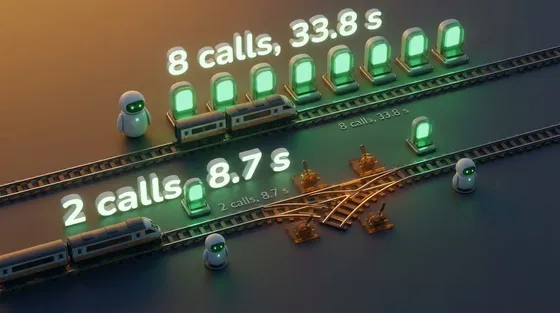
The same dinner booking, sent to Claude as a free-form tool loop and as a state machine. Per-state tool lists sent 61% fewer tokens, but with prompt caching on they cost 23% more on input, and with output counted the two came out about even. The real saving was code running the steps that need no model, 8 calls down to 2 and about 72% off the total, plus a table of every state against every event.
What it takes to make agents reliable enough to run in production.

Toolbench is a small framework for interactive tools in web pages. A tool is a pure function and a JSON manifest, and the runtime builds the form, runs the function and draws the answer. What it is, how it fits together, and the choices behind it, shown with tools that run live on mainLog.

The internals of toolbench, the framework behind mainLog's tools: what the runner guards against, why a worker exists only to be terminated, how a graph is laid out and routed the same in every browser, how known answers and size budgets keep tools honest, and why every migration is the identity function.
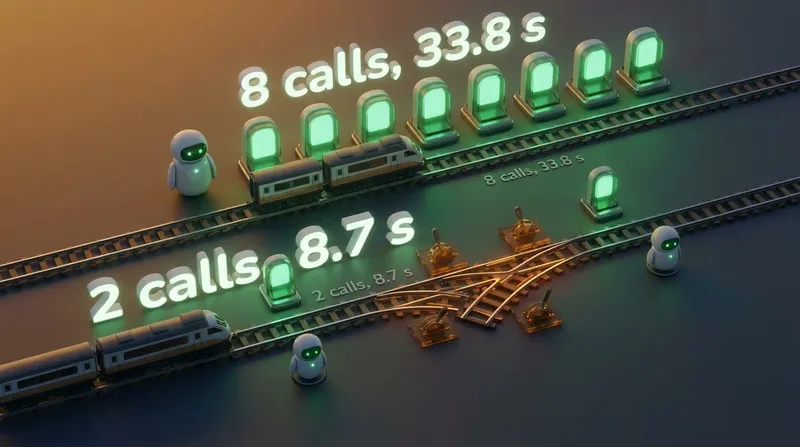
The same dinner booking, sent to Claude as a free-form tool loop and as a state machine. Per-state tool lists sent 61% fewer tokens, but with prompt caching on they cost 23% more on input, and with output counted the two came out about even. The real saving was code running the steps that need no model, 8 calls down to 2 and about 72% off the total, plus a table of every state against every event.
What it takes to make agents reliable enough to run in production.

